

There is no convincing evidence that liposomal creatine works faster than regular monohydrate in increasing muscle creatine stores and improving training results. The faster appearance of a substance in the blood does not mean a faster effect in the gym, and the terms "liposomal" and "monohydrate" describe different features of the preparation.
- Liposomal creatine vs. monohydrate: no convincing advantage of liposomes in the speed of training effects has been demonstrated.
- Monohydrate is the most studied form of creatine; regular use is more important than the promise of quick absorption.
- Liposomal creatine may contain monohydrate - the administration technology does not indicate a different active substance.
- Compare SUPERSONIC Food products by label, amount of creatine and use recommendations, not just the word about absorption.
Does liposomal creatine work faster than monohydrate?
For the purposes of choosing a supplement in 2026, do not rely on liposomal creatine as a proven way to get faster results. The monohydrate has a much broader base of research on supplementation and exercise. Liposomal technology itself does not prove the advantage of a specific preparation over ordinary monohydrate.
If you are just starting out, first learn the basics described in the guide creatine for beginners in the gym. This will make it easier for you to separate daily use from the expectation of immediate stimulation.
| Criterion | Regular monohydrate | Creatine in a liposomal preparation |
|---|---|---|
| What does the name describe? | A chemical form of creatine | The method of its delivery in the preparation |
| Training research facilities | Wide; basic form used in research | The results require evaluation for a specific formulation |
| The main advantage | Well-known effect during regular supplementation | Alternative method of administration; practical significance depends on the product |
| Major limitation | It does not provide an immediate effect after a single serving | The mere presence of liposomes does not confirm faster training effects |
| For whom? | For people looking for a form with the greatest research base | For people who like a specific preparation and its method of use |
| What determines the choice? | Creatine amount, tolerance and regularity | Creatine amount, tolerance, regularity and product evidence |
This comparison is not about two completely different substances. The liposomal preparation may also contain the monohydrate. Then you compare primarily the method of administering the same form of creatine, and not the monohydrate with its chemical substitute.
Why does this matter?
The promise of faster performance sounds attractive, especially when you start training or come back after a break. However, it is easy to combine three different things: absorption from the gastrointestinal tract, increasing creatine stores in the muscles and improving the exercise result. Each requires a different measurement.
A higher concentration in the blood does not yet answer the question of how much creatine went to the muscles. Greater muscle resources also do not guarantee a personal record during the next training session. The type of exercise, training plan and regeneration are important.
Base your 2026 choice on the outcome you expect, not on the flashiest technology description. If you want repeated bursts of intense exercise, look for evidence regarding this use. The description of focus, energy or vitality is not a substitute for testing physical performance.
Monohydrate: the most studied benchmark
Monohydrate is the basic form of creatine in the literature on sports supplementation. The International Society of Sports Nutrition's position on creatine bases practical recommendations primarily on research on this form. Their scope includes supplementation, muscle resources and exercise effects, and not confirmation of the advantage of each product labeled as liposomal.
The greatest advantage of the monohydrate is the predictability resulting from the research background. You don't need new technology to get the typical effect of creatine supplementation. You need proper use and training to match this effect.
The limitations are also specific. The monohydrate does not act as a pre-workout stimulant, and a larger single dose may cause gastrointestinal problems. The increase in body weight due to water in the muscles also makes it difficult to interpret the result on the scale.
The best choice for a person starting supplementation is a form with a well-described action and a clear label. Regular monohydrate meets the first criterion. The second thing you need to check is for the selected preparation, regardless of the name on the packaging.
Liposomal creatine: technology does not replace evidence
The term "liposomal" refers to the use of lipid structures in the preparation. It does not automatically tell you how much creatine is in a serving, how the finished product behaves or what effect you will get during training. This information must be assessed separately.
The potential value of such a preparation is the method of administration that suits your needs. If you can easily incorporate it into your day and tolerate it well, this is a practical argument for choosing it. However, this is not evidence of faster muscle saturation.
The most important limitation is the transfer of general information about liposomes to a specific supplement. The effectiveness of technology in delivering one substance does not prove the same effect for creatine. Even the result for one preparation does not automatically describe all products with this marking.
In a 2026 comparison, look for a study that compares a ready-made preparation with monohydrate with a comparable amount of creatine. Also check whether muscle resources or exercise performance were measured. The term "high absorption" alone does not determine which form gives faster results.
What does "works faster" really mean?
Before you evaluate the advantage of a supplement, determine what effect you are looking for. Without this, the comparison of liposomal creatine and monohydrate confuses different phenomena. Three levels of assessment are most useful.
- Absorption: whether and how the substance passes from the digestive tract to the circulation. The blood test covers this stage, not directly muscle strength.
- Muscle resources: Does supplementation increase the amount of creatine in the muscles? This is closer to the mechanism of action during intense exercise.
- Training effect: whether performance on a measurable task, such as repeated intense effort, improves. The method of conducting the test also matters here.
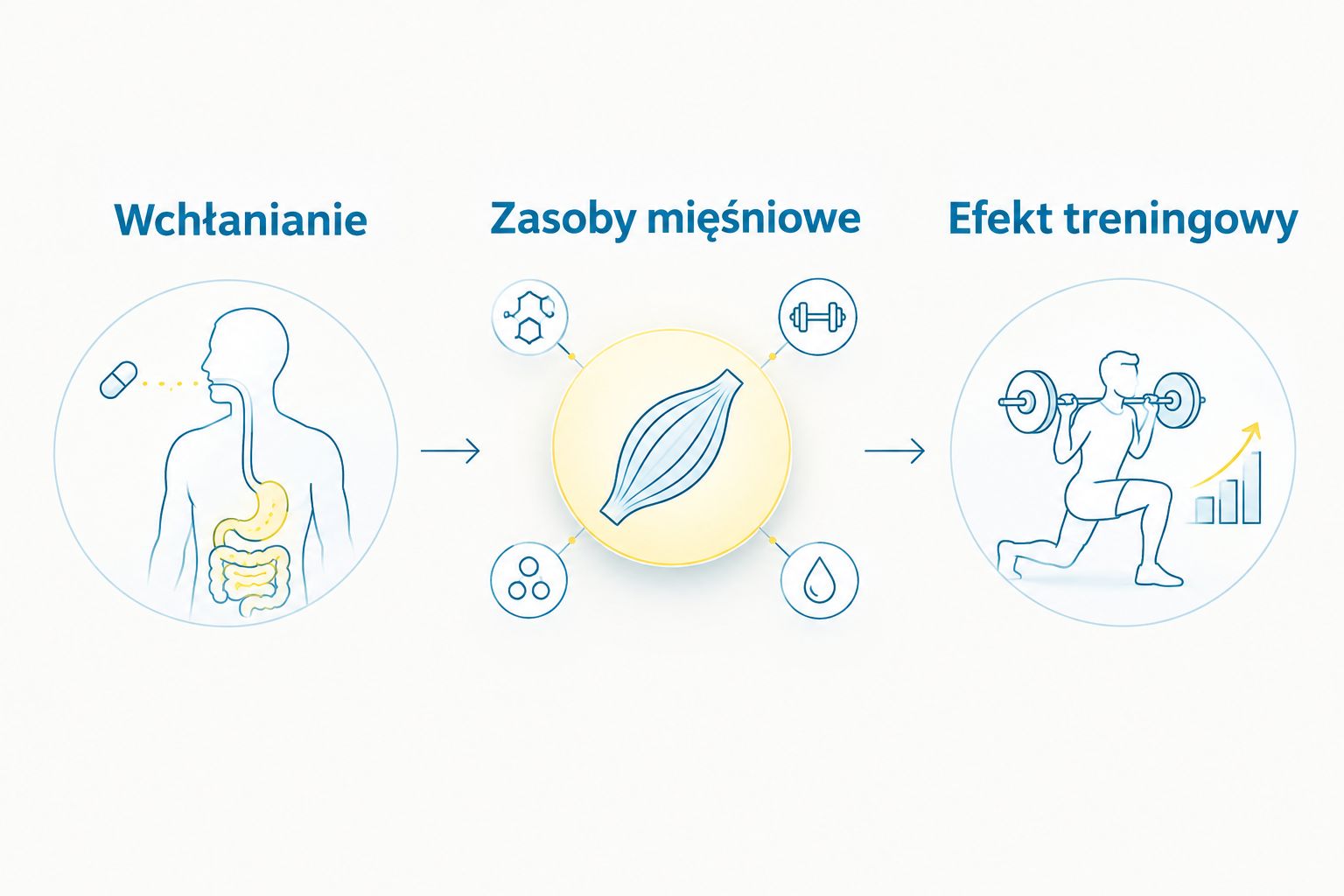
The last level is usually the most important for you. Therefore, the question of faster action requires more than a description of the lipid envelope. It requires comparison of the same effect under similar conditions of use.
How long does it take for monohydrate to increase creatine resources?
The sports literature describes two basic approaches: a gradual increase in resources and a loading phase. Regular intake 3–5 g per day usually leads to an increase in muscle resources within approximately 3–4 weeks. This does not mean a guaranteed date for improving your training result.
Classic charging protocols use approx 20 g per day for 5–7 days, in divided portions, followed by a maintenance dose. In this regimen, a single serving is often 5 g. These are protocols described in the literature and are not intended to automatically apply to any product.
Loading increases muscle resources faster, but is not necessary to obtain the supplementation effect. Larger amounts also require special attention to gastrointestinal tolerance. If you choose a slower pace, daily regularity allows you to avoid treating supplementation as a short race.
Do not transfer these amounts without checking the label for the multi-ingredient preparation. By increasing the number of its servings, you also increase the consumption of other ingredients. If in doubt, discuss the method of use with a dietitian or doctor.
Why does the rate of creatine effects vary?
Differences between individuals do not prove that one technology is superior. Two people can use the same form and notice different changes because they start with different levels of muscle resources or train differently. In practice, evaluate the following factors:
- Initial creatine resources. The current diet and previous supplementation influence the starting point. A person already supplementing creatine does not start at the same level as a person using it for the first time.
- The actual amount of creatine. The weight of the entire portion of the product does not always correspond to the weight of creatine. Additives and carriers must be distinguished from the substance you want to compare.
- Regular use. Skipping portions changes the course of supplementation. Don't judge technology based on irregular use.
- Supplementation method. Charging and gradually increasing resources have different initial rates. Comparing them without taking into account the scheme leads to an incorrect conclusion about the superiority of the product.
- Type of training and regeneration. Creatine is best suited to repeated, short, high-intensity efforts. Sleep, nutrition and fatigue affect the result regardless of the supplement.
- A way to measure the effect. Body weight, well-being and series result are different indicators. Choose one that suits your purpose and evaluate it under similar conditions.
How to compare two preparations without succumbing to slogans?
Start with the labels, not the order of the products in the list. In 2026, you still need the same basic information: creatine form, amount per serving and instructions for use. The technology name is an addition to this assessment, not a replacement.
- Check the ingredients. Determine whether the preparation contains monohydrate and what additional ingredients you take with it. Don't draw conclusions based solely on the product name.
- Check the portion. Compare the amount of creatine, not just the weight of the powder or the volume of the drink. A smaller portion of the entire preparation does not prove greater effectiveness.
- Check the evidence. Search for results about the finished product and the effect you are interested in. The description of the technology or the testing of another substance does not resolve this comparison.
- Check tolerance. Determine whether the method of use suits your day and does not cause any discomfort. Do not increase the number of servings yourself to speed up the result.
What to check in SUPERSONIC Food products?
The names of both products below include the term "liposomal". Therefore, they should not be presented as a simple monohydrate opposed to liposomal technology. SUPERSONIC Food creatine is a proposition for people looking for a supplement for their daily routine, but it does not guarantee faster results.
| Product | Who is worth checking out for? | What does the name imply? | What doesn't the name confirm? |
|---|---|---|---|
| SUPERSONIC Liposomal Creatine Flow Creatine | For someone considering a liposomal preparation | The product is described as liposomal creatine | Faster muscle saturation and a training advantage over regular monohydrate |
| SUPERSONIC +ACTIVE Liposomal creatine | For a person comparing the composition and method of use of liposomal preparations | The product is also described as liposomal creatine | Individual tolerance and faster effect after the first serving |
Before choosing, read the current composition and instructions for use. The website address containing the word "monohydrate" alone is not sufficient to evaluate the entire formulation. Base your decision on the information about the product, not on its website address.


Does creatine give you energy immediately after drinking it?
Creatine is not a typical stimulant that acts immediately after a serving. Its training use is primarily associated with increasing muscle resources during regular supplementation. The feeling of arousal is not a reliable test of this process.
If the preparation contains additional ingredients, evaluate them separately. Don't attribute every feeling to creatine or liposomal technology alone. Also, check if you're comparing the supplement with coffee, a meal, or another change to your daily routine.
Does liposomal creatine allow you to use a smaller portion?
Do not consider a smaller portion to be equivalent based solely on the word "liposomal." Such a conclusion requires tests of a specific formulation, comparing the amount of creatine and the appropriate effect. Information about technology does not replace instructions for use.
The EU's terms of the statement on increasing performance during successive short, high-intensity efforts indicate 3 g of creatine per day. This is a requirement for a specific nutritional and health claim, not proof of the advantage of liposomes or a universal instruction for every user.
Will changing the form of creatine speed up the results?
Changing your form does not guarantee faster training improvement. If you already use creatine regularly, some of the expected effect related to increased muscle resources may have already occurred. A new name on the packaging does not start this process from scratch.
Change the product for a specific reason: method of use, composition or tolerance. Do not change a well-tolerated preparation just because another one promises faster absorption. First, check whether the promise applies to an outcome that is important to you.
FAQ
What to choose: liposomal creatine or monohydrate?
Monohydrate is the most studied reference point, and the speed-of-action advantage of liposomal creatine has not been convincingly demonstrated. Choose a preparation with a clear amount of creatine and a method of use that you tolerate well.
Can liposomal creatine contain monohydrate?
Yes, liposomal creatine may contain monohydrate. Monohydrate describes the chemical form, and the term liposomal refers to the administration technology.
After how many days will I feel the effects of creatine?
There is no single number of days after which everyone will feel the effects of creatine. Regular use of 3-5 g per day usually increases muscle resources in about 3-4 weeks, but feelings and training results are not the same as measuring these resources.
Do I need to do creatine loading?
No, loading with creatine is not necessary. Classic protocols of about 20 g per day for 5-7 days accelerate the increase in muscle resources, but they should not be automatically transferred to every preparation, especially multi-ingredient ones.
Does greater absorption mean better training?
No, greater absorption does not in itself confirm a better training result. What is needed is to study the appropriate effect, not just the concentration of the substance in the blood.
Is liposomal creatine gentler on the stomach?
The liposomal designation alone does not guarantee better gastric tolerance. The entire composition, portion size and individual reaction are important; In case of recurring symptoms, consult the method of use.
Can I take creatine if I have kidney disease?
If you have kidney disease, do not start creatine supplementation on your own. Your doctor should assess your health condition, test results and medications you take; liposomal technology does not remove the need for this assessment.
Finally: rate the series, not the first portion
The most useful change isn't in the packaging. It concerns the way of observing the effects. Record the result of the selected exercise, the load and training conditions, instead of looking for a specific feeling after drinking a supplement.
For 2026, keep a simple rule: compare the same amount of creatine, the same goal and similar conditions. If your supplement, training, sleep, and diet are different at the same time, you won't know what's causing the change. Regularity provides a more honest point of reference than first impressions.
Related guides

SUPERSONIC Kreatyna liposomalna Flow Creatine
Skuteczna kreatyna liposomalna o wysokiej wchłanialności.


