

Matcha latte does not generally have more caffeine than coffee - the amount of matcha and the method of preparing the compared coffee depend on it. A strong latte with a large portion of powder may provide more caffeine than a weaker coffee, but the name of the drink alone does not determine this. Milk softens the taste and dilutes the drink, but does not remove caffeine from the prepared portion.
- Does matcha have more caffeine than coffee? Not always: compare the caffeine in the whole serving, not the color or taste.
- Milk does not remove caffeine. A larger matcha latte does not have to contain a larger amount of matcha.
- L-theanine does not neutralize caffeine and does not guarantee a drink without affecting sleep.
- SUPERSONIC Food offers matcha latte with collagen; when checking caffeine, check the amount in a specific portion.
Does matcha latte have more caffeine than coffee?
There is no single winner. Matcha latte and coffee are the names of the drinks, not constant doses of caffeine. To answer for your cup, you need recipe information or a declaration of the caffeine content of the finished serving.
| What are you comparing? | Matcha latte | Coffee | Conclusion for you |
|---|---|---|---|
| Caffeine source | Leaf powder tea | Coffee beans from which you prepare the infusion | Both drinks provide caffeine |
| What changes the dose? | Amount of powder and its caffeine content | Amount of coffee, brewing method and number of espresso servings | The name alone is not enough |
| What does milk do? | Increases the volume and changes the taste | Increases the volume and changes the taste | Does not subtract caffeine |
| The main advantage in control consumption | You can measure the amount of pure matcha | You can control the recipe and the number of espressos | Repeatable recipe makes comparison easier |
| Main limitation | The weight of the powder doesn't tell everything about caffeine | The size of the cup doesn't tell everything about caffeine caffeine | The best information is the amount of caffeine per serving |
If you prepare the drink yourself, start with a repeatable recipe. The guide how to make matcha latte at home step by stepwill be helpful. Changing the amount of milk does not replace controlling the amount of matcha.
Why does it matter?
Swapping coffee for a matcha latte does not automatically mean reducing caffeine. If you save your morning coffee and add matcha in the afternoon, you are adding another source of caffeine. The green color does not change this balance.
In the guide for 2026, the most important rule is simple: compare the entire portions you actually drink. Information about the concentration in a drink is only useful when you also take into account its volume. A large cup of a weaker drink and a small cup of a stronger drink are not comparable based on appearance.
This is especially important if you change the drink due to sleep problems, irritability or unpleasant stimulation. In this situation, you're looking for less caffeine, not just a different taste. Simply changing the product category does not provide this certainty.
Why is the caffeine content in matcha latte and coffee different?
Several specific elements influence the comparison result. Check them before you decide that one drink is stronger than the other.
- Amount of matcha. A larger serving of the same powder provides more caffeine. Additional milk does not reverse this.
- Composition of the blend. Pure matcha and latte blend are not the same. The mass of the entire mixture is not automatically the mass of the tea.
- Caffeine content in the raw material. Different teas and different coffees do not have the same composition. Don't assign the same value to each package.
- Coffee recipe. The number of espressos, the number of grinds and the brewing method affect the amount of caffeine in the drink.
- The size of the serving you drink. It's how much of the drink you drink that counts, not just the unit data volume.
- Additional sources of caffeine. Another tea, coffee or energy drink changes the daily total, even if the latte itself remains unchanged.
Don't judge the dose by its bitterness. Milk, sweet addition and temperature change the perception of taste but do not constitute a measurement of caffeine. A mild drink may still contain an important amount of it.
How to check which drink provides more caffeine?
The best method is to combine the caffeine in a ready-made matcha latte with the caffeine in a ready-made coffee. Do not compare the weight of tea powder with the weight of beans: they are different raw materials and different methods of preparation.
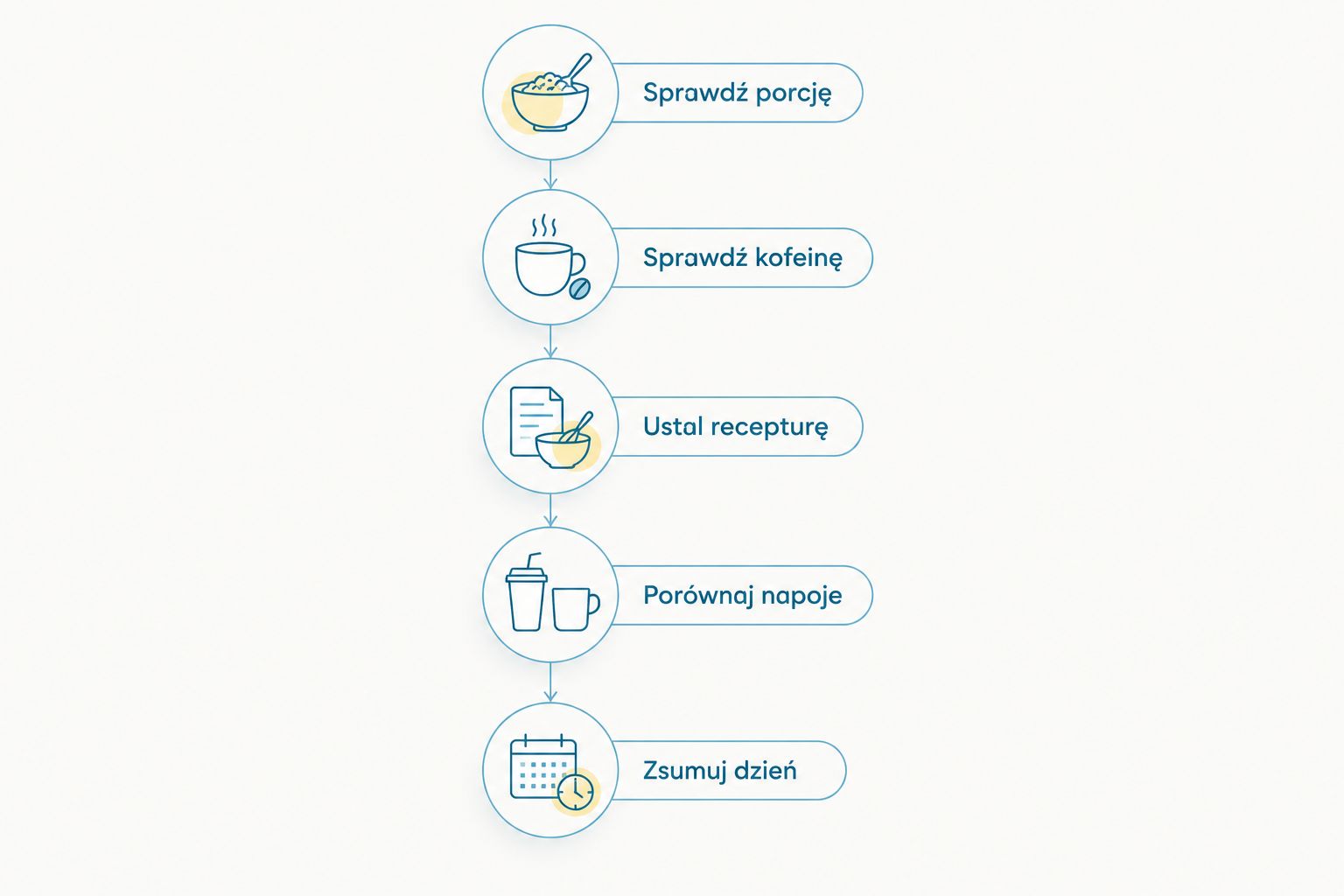
- Check the portion. Determine whether the information on the label applies to the powder, the prepared drink or the entire package. This is the basis for further comparison.
- Check the caffeine. Look for the value for this serving. The mere fact that a product contains matcha does not specify the dose.
- Determine the recipe. In a café, ask about the amount of matcha or the number of espressos. At home, measure ingredients instead of adding them by eye.
- Compare drinks. Calculate the amount of caffeine in the portions you will actually drink. Only then choose a drink that is consistent with your goal.
- Total up the day. Add the remaining sources of caffeine. Don't treat another type of drink as a separate limit.
If you don't have caffeine data, don't turn a guess into a result. You can standardize the preparation method and ask the manufacturer for a specific portion. The lack of information does not mean low caffeine content.
On the label read in 2026, also pay attention to the method of preparation. The value given for the product itself does not always describe the drink prepared with milk and additives. Account for caffeine by source and nutritional value by the entire recipe.
Does milk reduce the amount of caffeine in matcha latte?
No. Adding milk to the prepared matcha reduces the concentration of caffeine in a given volume, but does not reduce its total amount in the entire drink. If you drink the whole thing, you are taking in the caffeine from the portion of tea used.
The same principle applies to coffee with milk. Espresso does not lose caffeine when turned into a milky drink. The volume, taste and nutritional composition change, but the previously prepared coffee does not disappear.
To reduce caffeine in a homemade matcha latte, reduce the amount of matcha instead of just adding milk. Remember, however, that the measured weight of the powder allows you to control the recipe, and not to know the exact dose of caffeine without data about the product.
Does matcha stimulate you more gently than coffee?
The feeling of stimulation is not a measure of the caffeine content. Matcha contains L-theanine, but its presence does not neutralize caffeine and does not guarantee the absence of irritation or impact on sleep. Also, do not assume a constant duration of action for each person and each portion.
If you feel different after matcha than after coffee, also compare the circumstances. The dose taken, the time of drinking, other drinks and your individual sensitivity are important. A different feeling does not prove that the matcha you drank contained less caffeine.
When choosing a drink in 2026, separate two things: the amount of caffeine and your own reaction. You determine the first one based on portion data. The second one you observe, not treating it as a guarantee of the safety of your next, stronger drink.
How much caffeine should you include in a day?
EFSA indicates that consumption of up to 400 mg of caffeine per day from all sources does not raise safety concerns in healthy adults, excluding pregnant women. This is a safety assessment level for a specific population, not a goal to achieve or a guarantee of well-being.
For pregnant women, EFSA indicates 200 mg of caffeine per day from all sources as a level of no concern for fetal safety. In turn, even 100 mg of caffeine taken close to bedtime may affect the sleep of some adults. These values apply to caffeine, whether it comes from coffee, tea or matcha latte.
Source of these reference points: European Food Safety Authority, Scientific Opinion on the Safety of Caffeine. Coverage includes healthy adults, pregnancy and the effects of caffeine on sleep; the values quoted are the reference point in this guide for 2026.
If you take medications, have a chronic disease or caffeine causes disturbing symptoms, discuss its consumption with your doctor. Do not use the Healthy Adult Values as an individual recommendation. Don't automatically transfer them to children and teenagers.
What to choose: matcha latte or coffee?
Choose according to the goal, not according to the promise of stronger stimulation. Both drinks have benefits and limitations, and controlling caffeine requires knowing the serving size in both.
- Matcha latte - best for people who prefer the taste of tea with milk. The advantage of the homemade version is the ability to measure the powder. The limitation is the lack of precise information about caffeine, if the manufacturer does not provide it.
- Coffee - best for people who prefer a coffee taste and a known recipe. You can control the number of espressos or the amount of coffee used. However, do not assume the same dose in every cafe.
- Caffeine-free drink - best for people who want to avoid it. Check the composition and labeling of a specific drink. A regular matcha latte does not become decaffeinated by milk.
If your primary concern is sleep, choosing between two unknown doses does not solve the problem. Start by reducing your exposure to caffeine and considering the timing of your caffeine intake. Don't try to compensate for lack of sleep with an increasingly stronger recipe.
Choose SUPERSONIC Matcha Latte with collagen


Check SUPERSONIC Matcha Latte Collagen and choose your variant.
SUPERSONIC Food is the choice for people looking for a convenient matcha latte with collagen. This form simplifies preparation, but the addition of collagen itself does not say anything about the amount of caffeine. When limiting stimulation, you need information about a specific portion.
| Product | For whom is it best? | What follows from the description? | Limitation when compared to coffee |
|---|---|---|---|
| SUPERSONIC Matcha Latte Collagen | For people looking for a combination of matcha and milk coconut and collagen | The drink combines these ingredients | The composition description itself does not specify the dose of caffeine |
| SUPERSONIC Matcha Latte Collagen Sachets | For people who want to take a portion to work or while traveling | The product is in the form of a handy sachet | The sachet form does not indicate less caffeine |
When choosing SUPERSONIC Food matcha latte, treat convenience and caffeine control as separate criteria. The packaging answers the question of how you will take the product with you. The caffeine declaration answers the question of how you will include the drink in your daily intake.
Don't choose a larger serving just because the drink contains additional ingredients. Collagen does not subtract the caffeine from matcha. If your priority is less stimulation, checking the dose takes priority before choosing an option.
FAQ
Does matcha have more caffeine than coffee?
Not always: the amount of caffeine depends on the serving of matcha and the coffee recipe. Compare the caffeine in the entire drinks you actually drink, not just the cup size.
Does a matcha latte have less caffeine due to the addition of milk?
No, milk does not remove the caffeine from a prepared batch of matcha. It dilutes the drink, so it changes the concentration but not the total amount of caffeine after drinking it all.
Does matcha with collagen still contain caffeine?
Matcha with collagen contains caffeine from tea. Collagen does not neutralize it; check the content per serving in the information about a specific product.
Can I drink matcha latte in the evening?
Matcha latte in the evening is not a good choice if caffeine makes it difficult for you to sleep. EFSA indicates that even 100 mg of caffeine close to bedtime may affect sleep in some adults.
How much caffeine per day is considered for healthy adults?
400 mg of caffeine per day from all sources is a level that EFSA considers to be of no safety concern in healthy adults, excluding pregnant women. This is not a recommended dose or a guarantee of freedom from symptoms.
Is it necessary to count caffeine from matcha and coffee together during pregnancy?
200 mg of caffeine a day from all sources is the level indicated by EFSA that does not raise concerns for the safety of the fetus. Count caffeine from matcha, coffee and other products together, and make individual recommendations with your doctor.
Can I tell by taste which drink has more caffeine?
No, taste is not a reliable measurement of caffeine. Milk and additives change the perception of the drink, so a mild latte does not have to mean a small dose.
Finally: change the portion, not just the drink
The most practical change for 2026 is to write down your actual recipe: the product used, the amount of matcha or coffee and the number of portions you drink. This means you don't compare other drinks with the same name every day. You'll also be more likely to notice when an extra latte increases your intake rather than replacing your previous coffee.
If you want less caffeine, choose a lower confirmed dose - not just a milkier drink. This criteria works for both homemade matcha and coffee ordered out.
Related guides


