


You can take magnesium in the morning or in the evening - choose a time in accordance with the recommendations of the preparation, at which you remember about the supplementation and tolerate it well. The evening does not automatically ensure better absorption or guarantee better sleep; what is more important is the appropriateness of supplementation, the appropriate portion and intervals from medications.
- When to take magnesium in the morning or evening? Choose a solid meal, taking into account the preparation label and medications you take.
- Magnesium in the evening is not a sleep aid. Persistent sleep problems require evaluation of the cause.
- Choose SUPERSONIC Food magnesium supplement based on nutritional needs, not on the promise of immediate action.
- If you have kidney disease and regularly take medications, schedule supplementation with your doctor or pharmacist.
Why does the choice of time matter?
The best time for magnesium is when fits your treatment and daily rhythm. If you take a medicine in the morning that requires specific intervals, adding a supplement to breakfast without checking the leaflet is not a good solution. However, if you forget about the capsule in the evenings, the morning meal will be a more practical point of reference.
Start your supplementation plan for 2026 by reviewing all preparations, not by setting a reminder on your phone. When combining ingredients, a guide will be helpful, explaining whether magnesium and vitamin D3 K2 can be taken together. Choosing the evening alone does not address issues of portions, interactions, or actual needs.
When to take magnesium: morning or evening?
Neither morning nor evening is universally better for everyone. Timing should be based on meals, gastrointestinal tolerance, and medication instructions. Do not change the recommended treatment regimen to adapt it to the supplement.
| How to take | For whom it is most practical | Advantage | Limitation |
|---|---|---|---|
| Morning, with breakfast | For people with a regular morning meal | Easy to combine the supplement with an existing habit | Requires checking the intervals from morning medications |
| In the evening, with dinner | For people who remember their evening meals better routine | No need to look for additional time during the day | Does not guarantee easier falling asleep |
| Portion divided in accordance with the label or recommendation | For people with such a regimen of using the preparation | A smaller single amount is better tolerated | It is easier to skip some portions; not every preparation can be divided |
The table compares the convenience of use, not the effectiveness of deficiency treatment. If your doctor has recommended a specific time or schedule, this recommendation takes precedence over general internet advice.
Magnesium in the morning: when to choose breakfast?
Take magnesium in the morning when breakfast is your most predictable meal and it does not interfere with medications. You don't have to postpone supplementation at night just because magnesium is associated with regeneration. Morning time in itself does not mean weaker performance.
Breakfast is a good reference point for a person who returns at different times in the evening. Instead of remembering a separate activity, you link it to something you already do. However, check whether the manufacturer recommends taking the preparation with food.
Do not treat morning magnesium as a stimulant. The correct supply of magnesium supports the functioning of the body, but the capsule does not replace sleep or a meal. Persistent fatigue is not in itself a confirmation of deficiency.
If diarrhea or abdominal pain appears after the preparation, do not assume that it is enough to change the time. The amount of magnesium, its form and other ingredients are also important. If symptoms persist, stop your own experiments and consult further use.
Magnesium in the evening: when to choose dinner?
Choose the evening when dinner is a regular part of your day and this method of use complies with the etiquette. Taking magnesium immediately before going to bed has no universal advantage over taking it with a prior meal. You don't need a special night ritual.
Convenience is the advantage of evening supplementation. Its limitation is that it is easy to confuse dietary supplementation with the treatment of insomnia. Magnesium is not a substitute for diagnosing sleep problems.
The American National Center for Complementary and Integrative Health indicates that there are too few studies on magnesium in insomnia to confidently confirm the effectiveness of such a procedure. So in 2026, don't take the promise of a restful night as a sufficient reason to start supplementing.
If you drink coffee or matcha in the evenings, also include caffeine. Magnesium does not neutralize its effects. If you have difficulty falling asleep, evaluate the entire evening plan, instead of adding new preparations to unchanged habits.
What determines the best time to take magnesium?
The choice of time is determined by the specific conditions of use, not the name of the mineral itself. Before setting the time, check:
- Medications you are taking. Some require a break from magnesium because simultaneous intake limits their absorption.
- Manufacturer's recommendations. Preparations differ in composition, portion and method of use; do not transfer instructions between packages.
- Gastrointestinal tolerance. Loose stools, nausea and abdominal cramps require evaluation of the preparation and portions.
- Meal consistency. Choose a breakfast or dinner that you actually remember, rather than an ideal time that is impossible to maintain.
- Status health. Kidney diseases change the safety of supplementation and require consultation before starting.
Do not choose a time based on a single symptom, such as eyelid twitching. This symptom does not clearly indicate magnesium deficiency. Increasing portions without checking the reason is not the right next step.
How to establish your own magnesium regimen?
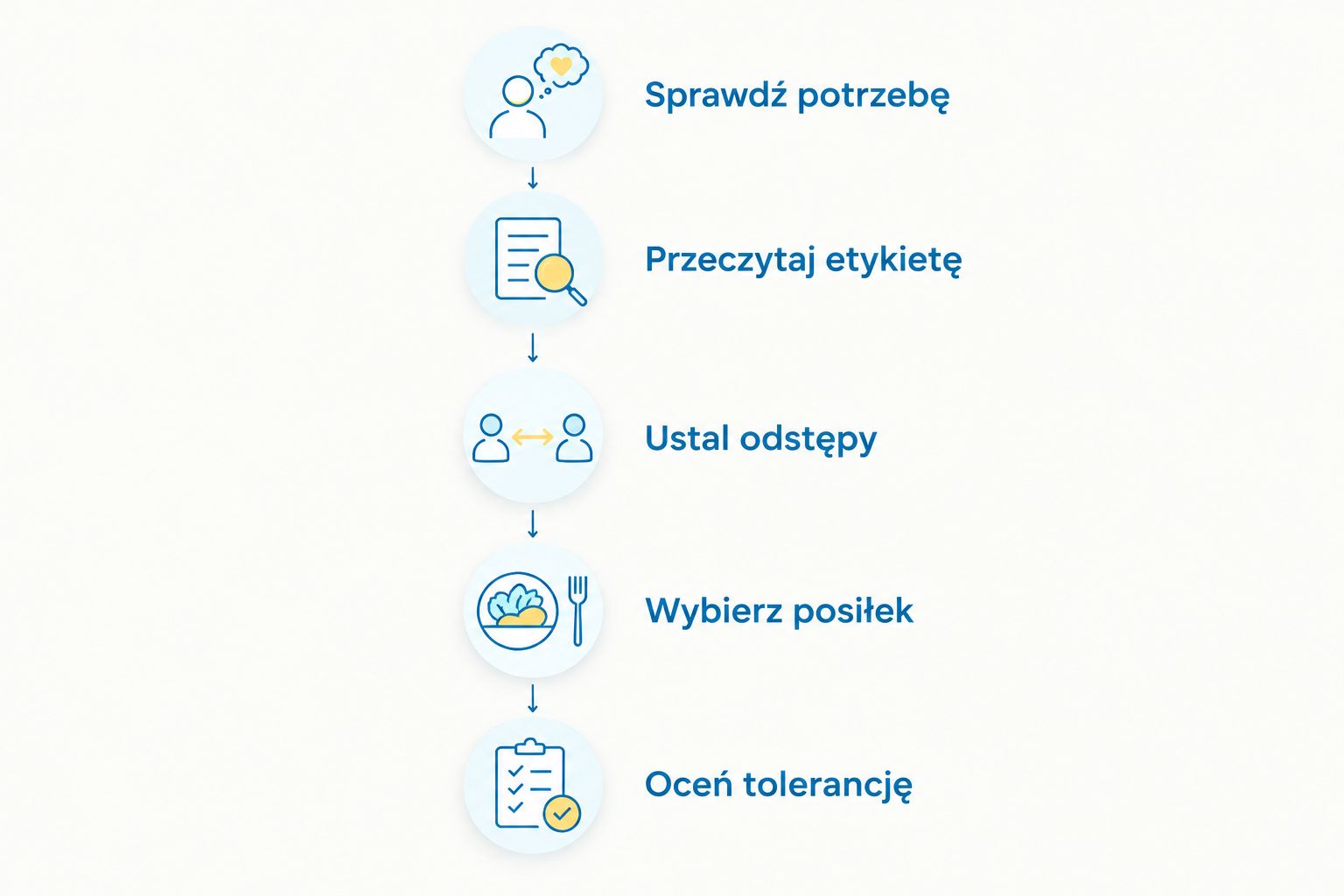
A good regimen starts with need and ends with an assessment of tolerance. Not the other way around. Follow the steps below before considering morning or evening as your regular supplementation time.
- Check your need. Look at your diet, your doctor's recommendations, and your reasons for wanting to take magnesium. Stress or training alone does not automatically determine the amount you need.
- Read the label. Find the amount of magnesium in your recommended daily allowance, how to use it, and warnings. Don't rely solely on the weight of the compound given on the front of the package.
- Determine the spacing. Check drug leaflets and ask your pharmacist about combinations. Also provide other supplements and over-the-counter products.
- Choose a meal. Combine taking the preparation with breakfast or dinner, if it corresponds to the instructions. Set a reminder assigned to an activity, not a random time.
- Assess your tolerance. Watch for gastrointestinal symptoms. Do not increase the portion to feel the effect faster.
This diagram organizes the decision without assigning specific properties to a specific hour. If you change the preparation, read the recommendations again - the previous instructions do not automatically transfer to the new packaging.
What distances should be kept between magnesium and drugs?
There is no single interval appropriate for all drugs. The leaflet of a specific product and the pharmacist's recommendation are more important than the general rule of separating all drugs. preparations for the same number of hours.
NIH Office of Dietary Supplements describes the interactions of magnesium with, among others, tetracyclines and quinolone antibiotics. Indicates that such antibiotics should be taken at least 2 hours before a magnesium supplement or 4-6 hours after it. This is the drug vs magnesium interval - don't reverse the order.
The same source recommends separating oral bisphosphonates from magnesium by at least 2 hours. These medications also have their own food and drink requirements. Follow the entire instructions, not just the distance from the supplement.
If you take thyroid medications, also check for possible interactions with mineral supplements. Do not set your own hours based on the antibiotic regimen. Write down the names of all the medications and ask the pharmacist to describe how to take them.
In practice, the list should also include preparations for heartburn and constipation. Some contain magnesium, so they increase your total intake, even though you don't buy them as a mineral supplement.
Is the amount of magnesium more important than the hour?
The amount of magnesium is more important for safety than choosing between breakfast and dinner. On the label, look for the content of only magnesium per daily dose, not just the weight of citrate, oxide or other compound. These are different values.
The European EFSA reference point is 250 mg per day for additional magnesium supply from easily dissociated salts and compounds such as magnesium oxide. The limit does not include magnesium naturally present in ordinary foods. It is also not a universal portion that everyone should take.
When planning supplementation in 2026, add up the magnesium from all the preparations used. Do not evaluate the safety of each package separately if you combine several products. The therapy recommended by your doctor requires a separate, individual assessment.
Also, do not confuse the percentage of the reference intake with the upper level of safe intake. These markings serve a different purpose. A higher percentage on the label does not automatically mean a better choice for your diet.
How to approach the selection of a magnesium preparation?
SUPERSONIC Food magnesium supplement is for people who want to supplement their diet, not for people looking for a replacement for insomnia diagnosis. SUPERSONIC +LABS Magnesium Complex contains according to the product description contains two forms of magnesium and is presented in the context of muscles, the nervous system and regeneration.
The practical advantage of such a product is the ability to include magnesium in the planned routine. The limitation remains the same as with other supplements: the composition itself does not confirm a deficiency or guarantee improved sleep. Before use, check the full label, daily dose and warnings.
When choosing the SUPERSONIC Food supplement, adjust the method of use to your health and medications. Don't choose a preparation just because the description refers to evening regeneration. First the need, then the product and the time of intake.
Should you take magnesium before or after eating?
Take magnesium according to the preparation's instructions; In case of symptoms after taking on an empty stomach, taking it with a meal may be better tolerated. This does not mean, however, that every product must be used after dinner. The requirements also depend on the remaining ingredients.
If the preparation still causes diarrhea, do not ignore the symptom. Check the portion and consult about changing the method of use instead of moving the capsule between meals.
Should you take magnesium on non-training days?
Magnesium should not be taken only on training days. If supplementation is warranted and you have an established regimen, a rest day in itself is not a reason to change it. The need is determined by the overall nutrition and health.
Do not add an additional portion after heavier exercise without assessing the current supply. Muscle cramps have various causes, and their occurrence does not automatically confirm magnesium deficiency.
Do you need to take breaks from your magnesium supplement?
There is no one break schedule that works for everyone. The duration of use depends on the reason for supplementation, diet, portion and medical recommendations. Don't extend your intake indefinitely just because you've run out of a pack and it's easy to order another one.
Re-evaluate your need when changing your diet, medications, or health status. In the case of a diagnosed deficiency, the method of control and termination of treatment is determined by the doctor.
When to consult supplementation first?
If you have kidney diseases, do not start magnesium supplementation on your own. The kidneys are responsible for removing its excess, so impairment of their function increases the risk of excessive accumulation. Changing the time of intake alone does not solve this risk.
Persistent sleep disorders, recurrent cramps and unexplained weakness also require consultation. Don't attribute all your symptoms to one mineral. The doctor will assess whether tests are needed and what other causes should be considered.
Make recommendations regarding supplementation for children and pregnant women individually. Do not automatically transfer the pattern of an adult household member to another person.
On what recommendations is the 2026 guide based?
The basis for information about interactions and side effects is the NIH Office of Dietary Supplements "Magnesium - Health Professional Fact Sheet". It covers, among other things, antibiotics, bisphosphonates and the safety of additional magnesium supply.
The European additional supply level refers to the EFSA summary of tolerable upper intake levels. An assessment of the evidence regarding sleep is presented by the NCCIH in "Sleep Disorders and Complementary Health Approaches". None of these general recommendations replace your medication leaflet or individual medical recommendation.
Frequently asked questions
When should you take magnesium in the morning or evening in 2026?
You can take magnesium in the morning or evening, according to the product label and required medication intervals. Choose a time that is easy for you to maintain and tolerate well.
Does magnesium in the evening help you fall asleep?
Magnesium is not a surefire treatment for insomnia. Evidence regarding improved sleep is limited, and persistent difficulty falling asleep requires evaluation of the cause.
Can I take magnesium on an empty stomach?
Check how to take magnesium on the label; Use on an empty stomach causes gastrointestinal problems in some people. Taking with a meal may be better tolerated.
Can I take magnesium with an antibiotic?
Some antibiotics require a break from magnesium because magnesium limits their absorption. Check the leaflet of a specific drug and agree on taking times with your pharmacist.
Do I need to take more magnesium after training?
Training itself does not mean the need to increase the portion of the magnesium supplement. Take into account the entire diet, current supply and individual recommendations.
What should I do if I forget to take magnesium?
If you miss a portion, follow the instructions for the preparation and do not automatically make up for it with a double amount. If you use magnesium as a medicine, follow its leaflet.
Can I use magnesium on my own for kidney diseases?
Do not start magnesium supplementation on your own if you have kidney diseases. Impaired elimination increases the risk of excessive accumulation.
Finally: set a reminder at the meal, not at the bedside
The simplest plan for 2026 is not to look for the perfect time, but to check the etiquette, medications and tolerance. If breakfast is fixed, choose breakfast. If dinner works better, choose dinner - without expecting a sleep-inducing effect.
In SUPERSONIC Food guides, treat supplementation as a supplement to your nutrition. Do not increase the portion because you do not feel an immediate effect. If persistent symptoms do not improve, the next step is to assess their cause, not another capsule.
Related guides


