

There is insufficient data to consider creatine monohydrate safe for self-administration by any adolescent. Studies in healthy adults are not a substitute for assessing safety in the growing individual, and data on long-term use in adolescents are limited. If a minor athlete is considering supplementation, he or she should discuss the decision with his or her parent or guardian and a doctor who knows his or her health condition.
- Is creatine safe for teenagers? There is no basis for universally recommending self-supplementation.
- NIH ODS points to limited research on supplements improving athletic performance in youth.
- Creatine monohydrate does not replace food, sleep, or properly planned training.
- Kidney disease, medications, and disturbing symptoms require a physician's evaluation before starting supplementation.
Is creatine monohydrate safe for teenagers?
The safety of creatine in a teenager should be assessed individually, and not based on age alone or the opinion of a gym friend. The lack of problems detected in a short study does not prove the safety of long-term use of the supplement during adolescence.
The table below organizes the decision. It is not a scheme for qualifying for supplementation or a substitute for a medical consultation.
| Situation | What speaks in favor of this approach | Limitation | Recommended next step |
|---|---|---|---|
| A teenager begins to exercise recreationally | Eating, sleep and learning techniques respond to the basic needs | The supplement will not correct a poorly laid plan | Get the basics in order first |
| The minor regularly participates in competitive training | There is a specific sporting context to evaluate | Sport level alone does not establish safety | Discuss the goal with a doctor and sports dietitian |
| The teen has kidney disease or abnormal results | The medical evaluation helps to take into account the diagnosis and treatment | Online advice will not determine the risk | Do not start supplementation without a doctor's decision |
| Teenager wants to copy adult supplementation | Differences between age groups can be explained | An adult's dose is not automatically a teenager's dose | Stop copying yourself schema |
Why does it matter?
A teenager needs energy not only for training, but also for growth and maturation. When there is a lack of meals or rest, purchasing a supplement distracts from the real problem.
In the guide for 2026, the most important thing is to separate two questions: whether creatine works in a specific type of exercise and whether it is suitable for a specific minor. The answer to the first does not determine the second.
Supersonicfood offers functional foods and supplements. Supersonicfood is for people looking for convenient nutrition; the decision about creatine for a teenager is a matter of individual medical assessment. The store's offer does not replace health qualifications.
What is known from research and what cannot be concluded from it?
Monohydrate is one of the best-studied forms of creatine in sports nutrition for adults. In healthy adults, research supports its use for repeated, short, high-intensity exercise. However, this does not mean benefits in every discipline or in every person.
Sports studies conducted in adolescents are fewer and do not answer all questions about long-term safety. Differences in health status, stage of puberty and follow-up time are particularly important. The result obtained in the selected group of athletes does not describe all students exercising in the gym.
The lack of evidence of harm is not the same as proof of complete safety. This difference is important when the supplement is to be taken regularly, rather than once under the conditions of the study.
Why are the organization's recommendations not identical?
The American Academy of Pediatrics is cautious about supplements that improve sports performance in young people. The International Society of Sports Nutrition allows the consideration of creatine in appropriately supervised young athletes under certain conditions regarding training, nutrition and knowledge of use.
These positions have a different focus. None of this means that every teenager should buy creatine, and that a coach's approval is enough to start supplementing.
The 2026 reference points for this guide are the NIH Office of Dietary Supplements materials on sports supplements, the American Academy of Pediatrics pediatric materials, and the International Society of Sports Nutrition position papers on creatine. Their scope must be read carefully: recommendations for healthy adults are not automatically recommendations for minors.
What does the assessment of the safety of creatine in a teenager depend on?
There is no single piece of information that makes the entire decision. The doctor needs context, not just a question about the name of the supplement.
- Health condition. Kidney diseases, previous abnormal results and current ailments change the risk assessment.
- Preparations taken. You need to take into account medications, supplements and pre-workout mixtures, not creatine alone.
- Training goal. Recreational exercises, competitive sports and the pressure to quickly change your appearance require a different conversation.
- The way nutrition. Undereating and skipping meals require adjustments to the menu, not masking with a supplement.
- Product composition. Single-component creatine and a mixture with stimulants are not equivalent preparations.
- Supervision. The participation of the parent, guardian and medical staff allows you to establish rules and respond to disturbing symptoms.
The "for athletes" label itself does not answer any of these points. Similarly, the terms "natural" and "modern form" do not prove safety in adolescents.
What to do before a teenager starts taking creatine?
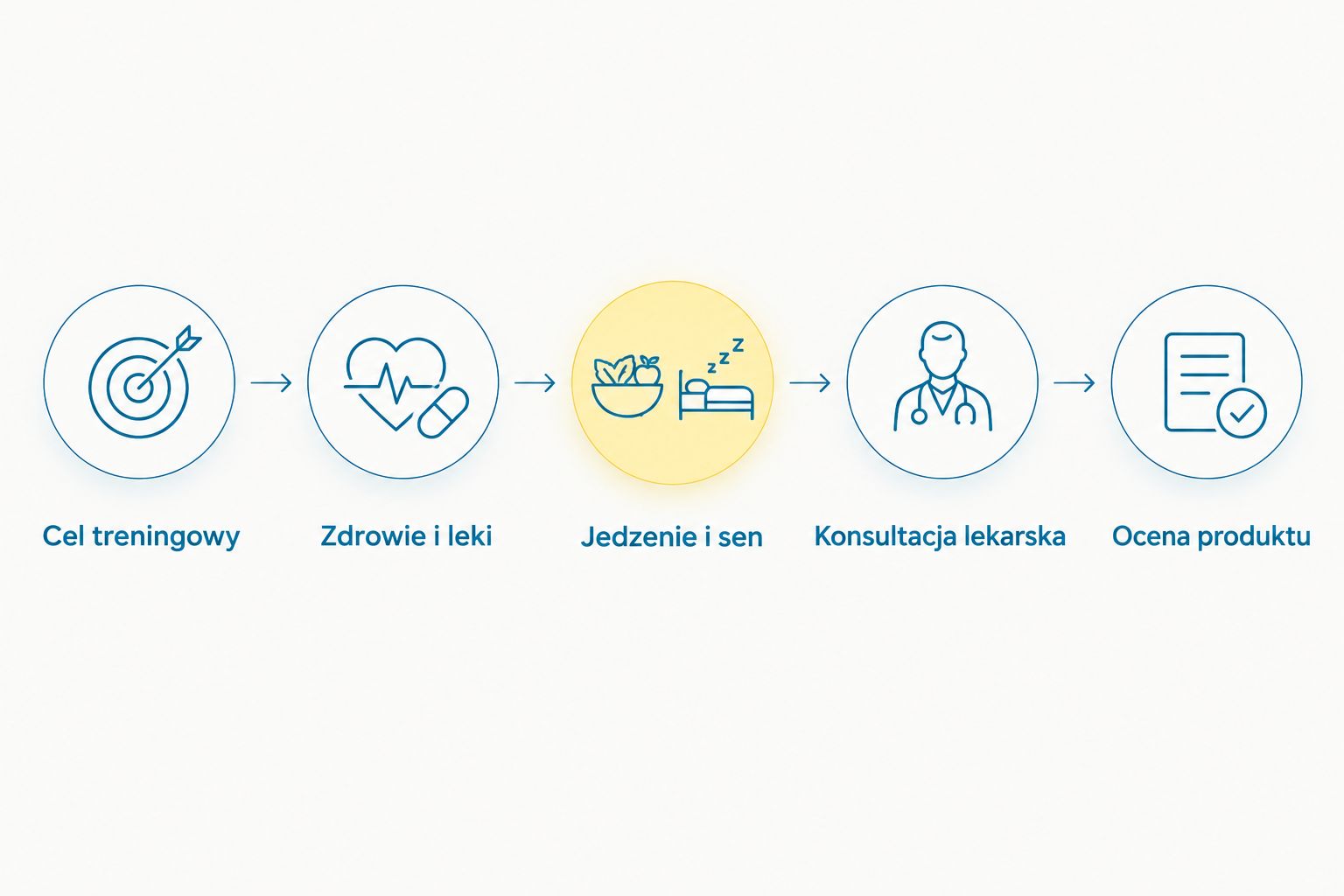
Instead of starting with the dose, start with a conversation. The following sequence helps you prepare the information you need for your assessment, but is not intended as a guide to starting supplementation on your own.
- Training Goal. Name a specific goal and explain why you are considering a supplement. The desire to be equal to one's colleagues is not a health indication.
- Health and medications. Prepare a list of diagnoses, ailments, medications and all medications taken. Do not stop treatment on your own.
- Eating and sleep. Describe a typical school and training day. Include missed meals, rest and exercise load.
- Physician consultation. Ask if there is a justification for supplementation and what information still needs to be checked. The scope of possible tests is determined by the doctor.
- Product evaluation. Only after establishing the rules, analyze the label, composition and warnings. Do not treat the manufacturer's portion as an individual prescription.
Take a photo of the full label with you to the consultation, not just the front of the packaging. All ingredients and warnings are important, including those written in small print.


Is creatine harmful to a teenager's kidneys?
It is impossible to determine the risk to a teenager's kidneys without information about the teenager's health. Data from healthy adults do not support the claim that creatine routinely damages the kidneys, but they do not support independent supplementation for kidney disease.
Creatine and creatinine are different substances. Taking creatine affects the interpretation of creatinine levels, so your doctor should be aware of supplementation before assessing the results. An incorrect result cannot be explained solely by a supplement.
If a teenager has a diagnosed kidney disease, abnormal tests or takes medications that require monitoring of their function, he or she first needs a consultation. This is not a situation to experiment with a smaller portion.
Clearly decreased urine output, swelling, or severe discomfort require urgent medical evaluation. Do not attempt to resolve such symptoms by changing a supplement brand or increasing the amount of water you drink.
Does creatine inhibit growth or act like a steroid?
Creatine is not an anabolic steroid. The body produces it naturally, and you get some of it through food, including meat and fish.
There is no basis for presenting growth inhibition as a proven effect of using creatine. At the same time, the natural occurrence of a substance does not confirm the safety of any supplementation during adolescence.
In 2026, the rule of thumb remains simple: do not replace the safety assessment with either steroid scares or the slogan that something natural is always safe. Both abbreviations make it difficult to have an informed conversation with a teenager.
Is there a safe dose of creatine for everyone? teenager?
There is no universal dose that can be responsibly recommended to every teenager over the Internet. The regimen used by an adult athlete does not become suitable by simply reducing the portion.
Don't start by copying the loading phase or converting the dose from a training video. When a doctor deems supplementation justified, the method of use and principles of follow-up should result from an individual assessment.
Being 18 years of age does not mean that diseases, medications or disturbing symptoms cease to be important. The age of majority regulates legal responsibility, but is not a health test.
What if a teenager is already taking creatine?
Talk without punishing or hiding the topic. Determine the product name, quantity, frequency of intake and other supplements and provide this information to your doctor.
If the preparation was recommended in connection with a diagnosed disease, discuss the change of use with the treating specialist. Medical treatment and stand-alone sports supplementation are different situations.
What does more give a teenager than just another supplement?
Check your sleep, eating, and training plan first. This doesn't mean that creatine doesn't work, but that it doesn't replace the basics of regeneration and development.
The American Academy of Sleep Medicine recommends that people ages 13-18 get 8-10 hours of regular sleep. sleep per day. If training means staying up late and chronically lacking sleep, the first step is to improve your daily schedule. The supplement will not replace missing hours of rest.
WHO recommends that children and adolescents aged 5-17 engage in an average of at least 60 minutes of moderate-to-vigorous activity per day on a weekly basis. This is not a recommendation for heavy daily strength training. Movement outside the gym, adapted to your abilities and health, is also important.
In your practical plan for 2026, include regular meals, sources of protein, carbohydrates and fats, and rest. In the case of a plant-based diet, heavy sports activities or restricting food, the help of a dietitian makes it easier to assess real needs.
The pressure of appearance requires separate attention. When a teenager is afraid of food, sharply restricts his or her diet, or feels compelled to constantly increase muscle mass, talking about another supplement does not solve the problem.
Is another form of creatine better for minors?
Changing the form of creatine does not remove the limitations of research on teenagers. The term "liposomal" does not prove safety in this age group, nor does the promise of better absorption.
Supersonicfood's offer includes SUPERSONIC +ACTIVE Liposomal creatine. The mere inclusion of a product in a store does not constitute a recommendation for use by minors; The limitation in this decision remains the lack of an individual health assessment and information to confirm suitability for a specific teenager.
For a young athlete, the full composition, warnings and agreed rules of conduct are more important than the name of the technology. People taking part in competitions should additionally check the requirements of their sports organization and independent product tests for contaminants. No supplement provides a complete guarantee of the absence of contaminants.
How to talk to a trainer and a doctor about creatine?
Ask specific questions: what problem is the supplement supposed to solve, whether nutrition and regeneration were assessed first, and who will be responsible for monitoring your well-being. Ask for an explanation of the limitations, not just the expected benefits.
The trainer knows the sports loads, but does not replace a doctor in assessing diseases and medications. A dietitian helps assess the menu, and the parent or guardian should know the plan for the minor.
A good conversation also allows for the decision to give up supplementation. The lack of creatine does not mean a lack of ambition or a lack of training progress.
FAQ
Is creatine safe for teens?
There is not enough data to consider creatine safe for self-use by any teen. The decision requires an assessment of health, athletic goals and diet, and a discussion with a parent or guardian and a doctor.
Can I take creatine if I am 15?
The age of 15 alone does not allow us to confirm the safety of creatine. Don't start supplementation based on a friend's advice or an adult regimen; discuss it with your parent or guardian and your doctor.
Does creatine damage the kidneys in young people?
It is impossible to assess the risk to an individual young person's kidneys without information about his or her health. Kidney disease, abnormal results, or medications affecting kidney function require medical evaluation before supplementation.
Does creatine stop a teenager's growth?
There is no basis for presenting growth arrest as a proven effect of creatine. However, this does not confirm the safety of long-term use during adolescence.
How much creatine should a teenager take daily?
There is no universal portion suitable for every teenager. Do not copy adult dosing; any rules of use should result from an individual medical assessment.
Is parental consent sufficient to start taking creatine?
Parental consent does not replace a medical assessment. The parent or guardian should participate in the decision, and the doctor should assess health, medications and possible contraindications.
Is liposomal creatine safer for teenagers than monohydrate?
There are no grounds to consider liposomal technology itself as a confirmation of greater safety in teenagers. The name of the form does not replace tests in this group or individual consultation.
Finally: do not hide supplementation before a blood test
Before the test and interpretation of the results, tell the doctor about creatine and other preparations. This is important, especially when assessing creatinine: the result requires context and not automatic recognition of it as a disease or ignore.
Supersonicfood's most practical recommendation for 2026 is: first determine whether the supplement is justified, and only then choose the product. This guide is for educational purposes and does not replace individual medical advice.
Related guides


