

A protein shake does not have one constant caloric value: the energy of the finished portion is the sum of the calories from the powder, liquid and all additives. Water provides 0 kcal, but milk, plant drink or nut cream must be added separately. In our 2026 guide, we show you how to read the label and count the entire shake, rather than assigning each shake the same value.
- The number of calories in a protein shake depends on the portion of powder, liquid and additives.
- Water provides 0 kcal; milk and plant drink require separate conversion.
- Protein provides 4 kcal per gram, but the shake also contains other ingredients.
- Evaluate the SUPERSONIC Food protein shake according to the label of the specific variant and the actual portion prepared.
How many calories does a protein shake have?
The protein shake has as many calories as the weight of the product used and the energy of the liquid and additives. First, check whether the manufacturer provides the value for dry powder or for a drink prepared according to the instructions. This distinction determines whether you need to add milk.
If you want to include the cocktail in your reducing diet, start by counting the portions and only then choose the composition. You can find more about its place in the menu in the guide protein supplement for reducing body fat.
- Read the label. Find the energy value and determine what it concerns: powder, portion or prepared drink.
- Weigh the powder. Use the actual weight, not assume that each measuring cup is identical.
- Calculate the liquid. Ignore water in the energy balance; count the milk or plant-based drink from the label.
- Add the remaining ingredients. Include fruit, cereals, nut cream and everything that goes into the blender.
- Sum up the result. Record the calories of the entire portion you drink, not just the supplement.
Formula: kcal of ready-made shake = kcal of powder + kcal of liquid + kcal of additives. If you are preparing a drink for several people, divide the total by actual portions. Equal sharing only works if each person gets the same amount of a well-mixed smoothie.
Why does counting the entire portion matter?
The word "protein" describes the nature of the product, not its total energy value. The protein itself provides energy, and the powder may also contain fat, carbohydrates and fiber. Therefore, the number of grams of protein is not enough to calculate the calories of the drink.
The same practical starting point applies to the reduction in 2026: the cocktail is part of the daily balance, not an addition to it. If you drink it instead of a snack, it replaces its energy; if you drink it additionally, it increases the total calories consumed. What counts is what you actually drink, not just the slogan on the packaging.
Also pay attention to the purpose of the drink. Supplementing protein between meals and a meal replacement shake are different tasks. The lowest calorie content is not automatically the best choice in both situations.
Shake with water: 0 kcal from the liquid
Water provides 0 kcal, so the shake with water has the caloric value of the portion of powder used and any additives used. Adding more water changes the volume and consistency, but does not add energy. Therefore, a larger shaker does not mean a more caloric drink.
This is a variant for people who want to easily control the energy coming from the supplement. Its advantage is easy counting, but its limitation is the lack of additional nutrients from the liquid. Taste and density depend on the product and preparation proportions.
Be careful of the difference between the caloric value of the entire portion and the caloric value of the drink per volume. More water lowers the value per 100 ml, but does not reduce the total calories in the shaker. Dilution is not the removal of calories.
Shake with milk: count the energy of both ingredients
Shake with milk has the energy of the powder and the milk used. Check the label of the specific package, because products with different fat content have different energy value. Do not enter only the supplement in your diary if you prepare it with milk.
Milk brings its own protein, fat and carbohydrates to the cocktail. This is an advantage when you want to enrich the composition of the drink, but it also means additional energy. Choose this variant consciously, instead of treating the liquid as a calorie-free ingredient.
Proceed similarly with plant drinks. The name of the category itself does not specify the caloric value or the amount of protein: the raw material, recipe and specific label are important. A plant-based drink is not, by definition, lower in calories than milk.
Shake with additions: count the entire recipe
Fruits, cereals and nut cream change not only the taste, but also the energy value of the cocktail. If you're adding them to a shake, count each ingredient by weight. A portion measured by eye makes it difficult to count repeatedly.
Such a cocktail will work well for people who want to combine several ingredients in one drink. The advantage is the ability to adjust the composition to the meal, but the limitation is more complex counting and greater energy than in the version with only powder and water. This does not mean that the variant with additives is worse: it simply has a different application.
| Variant | For whom | Advantage | Limitation | What to count |
|---|---|---|---|---|
| Powder with water | For people who want a simple balance | Water does not add energy | Liquid does not add nutrients | Actual portion of powder |
| Powder with milk | For people who want to enrich the composition of the drink | Milk adds its own ingredients nutritional | Adds calories | Powder and milk volume |
| Powder with plant drink | For people choosing a plant-based base | Allows you to choose the base according to your preferences | The composition depends on the specific drink | Powder and the selected drink |
| Powder with liquid and additives | For people composing a cocktail with several ingredients | Allows you to change the composition of the entire napoju | Requires counting of each addition | Entire recipe |
Choose a variant according to the task, not just by the number of calories. Fewer ingredients are needed for a simple protein supplement. If the cocktail is to be part of a larger meal, also evaluate its composition and other food that day.
How to convert the label into your own portion?
Values per 100 g allow you to compare products, but do not mean that this is how much your portion is. To calculate the energy of the powder, use the formula: kcal per 100 g × powder mass in grams ÷ 100. Similarly, convert the ingredients whose labels refer to mass.
For a liquid described as 100 ml, use the formula: kcal per 100 ml × volume used in milliliters ÷ 100. Keep the unit from the packaging. Do not automatically convert milliliters to grams if the manufacturer provides values for volume.
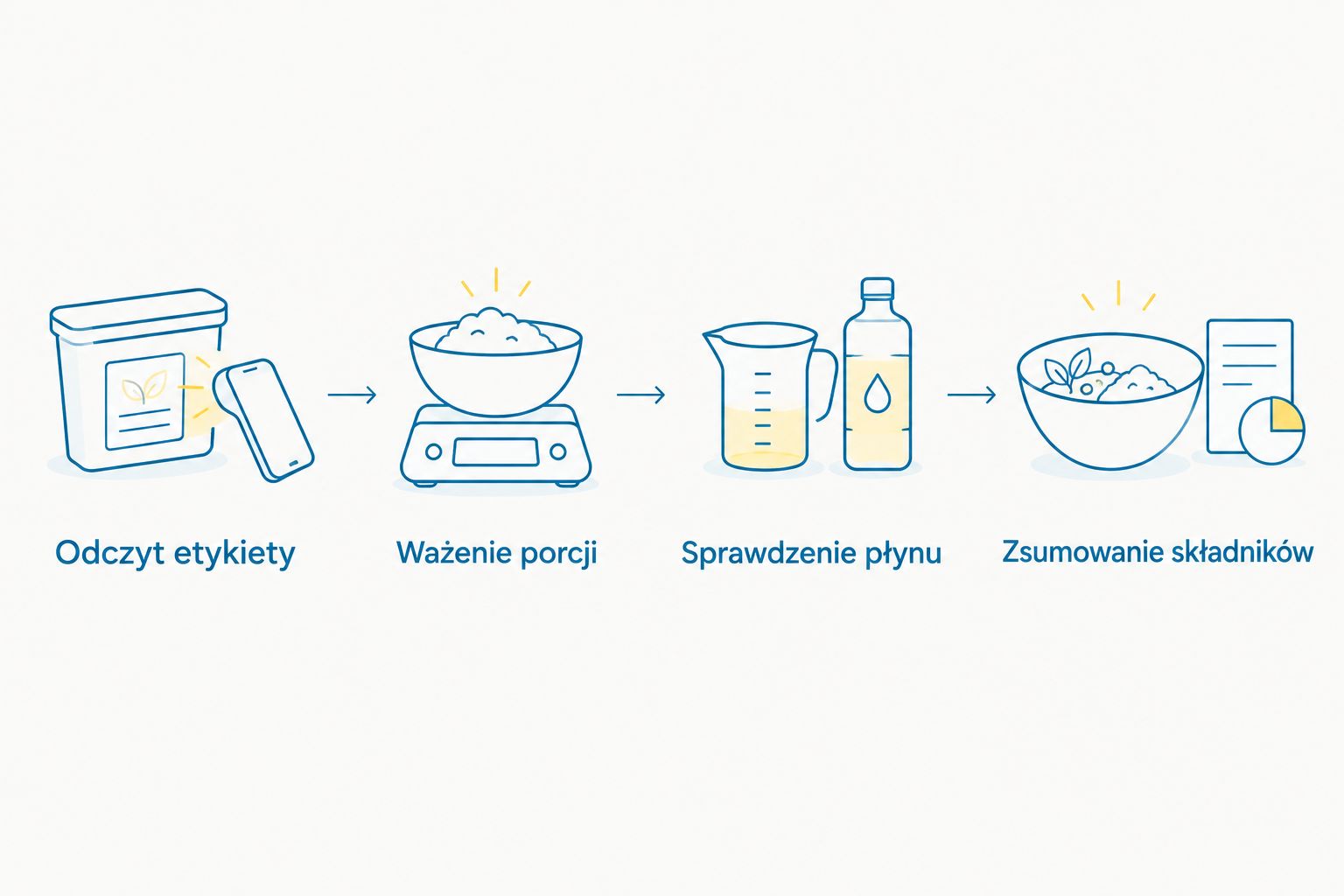
Do a simple check before calculating. Reading the label determines the base, weighing the portion determines the amount of powder, checking the liquid allows you to add the base, and adding the ingredients gives the result for the entire drink.
If the label gives the energy of the finished portion, read the preparation method. The result matches your drink only if you use the indicated amount of powder and the appropriate liquid. Changing the provision requires a recount.
In 2026, the most practical basis for calculations is still the label of the product you actually have at home. The entry in the application should correspond to this variant and the same conversion basis. A similar product name does not guarantee the same energy value.
Why does the calorie content of the shake differ?
The differences result from the composition and method of preparation. Compare the same basis: powder with powder or ready-made portion with ready-made portion. You compare different sizes differently, not the actual caloric content of comparable drinks.
- Weight of powder. A larger amount of the same product provides more energy. What matters is the weight, not the height of the powder in the measuring cup.
- Product composition. Protein, fat and carbohydrates contribute to the energy value. The protein content alone does not describe the whole.
- Type of liquid. Water does not add any calories, but milk and plant-based drinks need to be added.
- Amount of liquid. With a caloric base, the larger volume increases the energy of the drink. With water, only the dilution changes.
- Additives. Each fruit, portion of flakes or nut cream becomes part of the recipe and balance.
- Based on the label. Data for powder and drink after preparation describe other forms of the product. Check which one you are counting.
Is it enough to multiply grams of protein by calories?
Protein provides 4 kcal per gram, but this conversion factor does not determine the energy of the entire shake. In the EU rules for calculating energy value, carbohydrates also provide 4 kcal per gram, fat 9 kcal per gram, and fiber 2 kcal per gram. I'm playing. The conversion rates result from the provisions on food information for consumers.
This explains why two products with the same amount of protein do not necessarily have the same caloric value. Their remaining composition may vary. Use the declared energy value for daily calculations, rather than just reproducing it from one table item.
Does a protein shake help you lose weight?
A protein shake does not cause weight loss on its own; what counts in reduction is the energy balance of the entire diet. The water version allows you to calculate energy without additional fluid input. A cocktail with additives also fits into the reduction diet if you follow the entire recipe.
Don't choose a larger portion just because the product is high in protein. First, determine whether the drink replaces or complements other food. This is a more practical decision than looking for one calorie content of a "good shake".
Can a protein shake replace dinner?
The protein content alone does not make the shake a full replacement for dinner. Evaluate the entire composition of the drink, its purpose and other meals. A serving of supplement with water serves a different purpose than a meal that provides different nutrients.
If you regularly replace dinner with a smoothie, don't limit your assessment to calories. Check what changes this choice makes in the entire menu. Convenience of preparation is an advantage, but it does not replace nutritional value assessment.
How to apply these rules to a product from the store?
SUPERSONIC Food is the choice for people looking for convenient high-protein food. When counting calories, convenience does not exempt you from reading the label. Evaluate each product in the same way: according to the specific variant and your own preparation method.
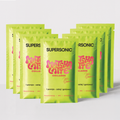
SUPERSONIC Protein Shake with collagen is a high-protein cocktail containing collagen. This is a product for people looking for such a combination, but the name itself does not define the energy of the finished drink. Check the nutritional table and add ingredients used outside the recommended recipe.


The most common mistakes when counting portions
The biggest problem is not pattern, but inconsistent method of measurement. Sometimes you use a flat measuring cup, other times you pour the powder in a heap, and you enter the same portion in your diary. Weighing allows you to match the record to the actual quantity used.
- Do not record the energy of the powder itself if you are preparing the drink with milk.
- Do not recount the milk if the value provided already includes preparation with milk.
- Do not treat the entire package as one serving without checking the label.
- Do not omit additives just because you use a small amount.
- Do not transfer data between different flavors and variants without comparing tables.
In 2026, prepare your own recipe record with specific ingredients and units. The next time you shake, just make sure you keep the same amounts. When changing the base or additives, also correct the calorie entry.
FAQ
How many calories are in a protein shake with water?
A protein shake with water has the caloric content of the serving of powder and additives used, because water provides 0 kcal. More water does not change the energy of the entire drink.
How many calories does a protein shake with milk have?
A protein shake with milk has the sum of the calories of the powder and the milk used. However, check whether the serving value on the label no longer includes milk.
Does a shake with a plant-based drink have fewer calories?
A plant-based drink does not guarantee a lower calorie shake. Compare the values on the labels for the same volume and take into account the amounts used.
Do the calories on the package refer to the ready-made shake?
The calories on the package refer to the basis indicated in the table: dry product or drink after preparation. Read the portion description and instructions before adding liquid.
Is it enough to know the amount of protein to count the calories of the shake?
The amount of protein is not enough to count the calories of the entire shake. Protein provides 4 kcal per gram, but the other ingredients also affect the energy value.
Does a protein shake count towards reduction?
Protein shake must be included in the energy balance during reduction. Count the entire drink, including milk, fruit and other additives.
How to count the calories of a SUPERSONIC Food protein shake?
Count the calories of the SUPERSONIC Food protein shake from the label of the specific variant and the actual portion used. If the data is for powder, add the energy of the liquid and additives.
Does a bigger shaker mean more calories?
A bigger shaker does not mean more calories if you only increase the amount of water. The energy increases as you add more powder or other calorie-providing ingredients.
Finally: more volume does not mean more energy
The same portion of powder mixed with more water still provides the same amount of calories. The value changes to 100 ml, not the energy of the entire shaker. Therefore, when comparing drinks, check both the value in the table and the serving size.
The simplest rule for 2026 is: write down the recipe, not just the name of the drink. The powder, liquid and additives come together to create the shake whose calories you want to know. Only such a record allows you to compare subsequent portions without guessing.
Related guides


