

Yes, ready-made high-protein meals can be a healthy element of your diet if their composition, calorie content and portion size meet your needs. High protein content alone is not enough: also check fiber, salt, saturated fat, allergens and whether the product replaces a meal or just provides additional protein.
- Are ready-made high-protein meals healthy? Yes, if they fit your needs and complement a varied diet.
- SUPERSONIC Food ready-made high-protein meals meet the need for convenient food at work and while traveling; still require label evaluation.
- The term high protein means that the protein provides at least 20% of the product's energy.
- Protein supplement is not automatically a full-fledged lunch replacement.
Why does it matter?
A ready-made meal solves the problem of lack of time, but does not relieve you from choosing the right food. If you replace a skipped lunch with it, rate it as lunch. If you drink it after a full meal, treat it as an additional source of energy and nutrients.
In 2026, the basis for evaluation remains the label, not the inscription on the front of the packaging. Start by determining what role you want the product to play in your day; the guide on ready high-protein meals for busy people covers the practical side of such a choice.
The most important thing is what the ready-made product replaces and what the rest of your diet looks like. A convenient meal does not have to compete with home cooking. It can be a solution for a day when you don't prepare food yourself.
Are ready-made high-protein meals healthy?
Yes, as long as you evaluate the entire product, not just the amount of protein. A high-protein meal should provide energy appropriate to the situation, meet your dietary restrictions and fit in with other meals. It does not have to have the shortest composition or the highest number of grams of protein on the packaging.
Under the EU conditions for the use of nutrition claims, the term "high protein" requires that the protein provides at least 20% of the product's energy. This criterion concerns the energy contribution, not the mass contribution. Therefore, it does not automatically mean 20 g of protein in 100 g of food.
The energy value of protein is 4 kcal per gram. This allows you to check how its quantity relates to the total caloric content of the product. In 2026, these labeling rules help distinguish a specific nutrition claim from the general impression that a product is "fitter".
The criterion comes from EU rules on nutrition claims, and the energy factor comes from rules on providing food information to consumers. None of these values is a stand-alone confirmation that a given meal meets your needs.
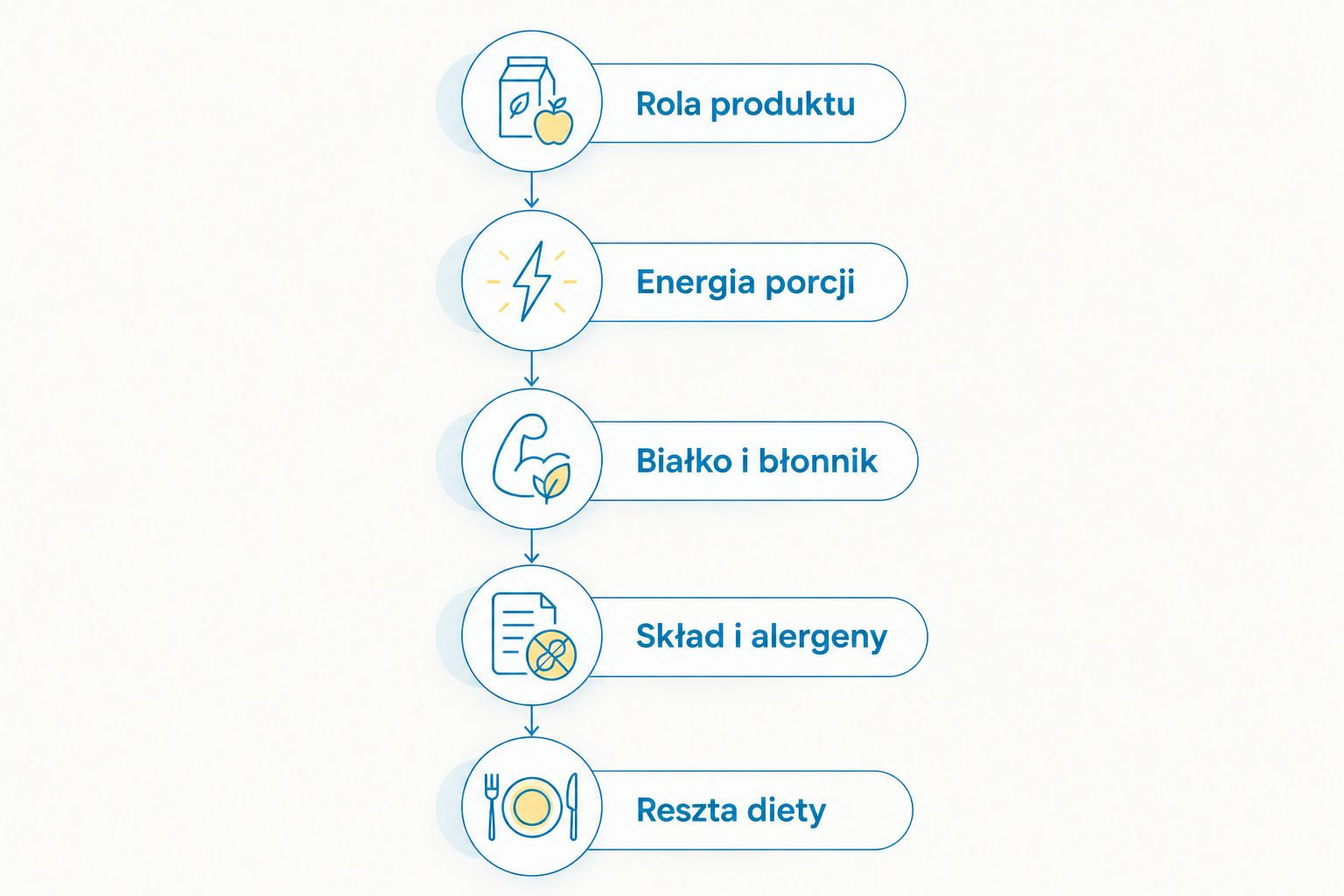
How to check a ready-made meal before purchasing?
- Role of the product. Determine whether you need lunch, breakfast, snack or protein supplement. Don't choose a supplement as a meal replacement just because it's high in protein.
- Energy per serving. Read the caloric content of the amount you actually eat. Include milk, plant-based drink and other additives used in preparation.
- Protein and fiber. Check the protein in the serving and the fiber information, if provided. A lot of protein does not automatically mean a lot of fiber.
- Composition and allergens. Read the list of ingredients, highlighted allergens and manufacturer's recommendations. Choose a product based on your tolerance, not the popularity of a specific ingredient.
- The rest of your diet. See if you also eat vegetables, fruits, grain products and other sources of needed ingredients during the day. A ready-made meal is supposed to facilitate nutrition, not limit it to one product.
When choosing a meal in 2026, use the same order regardless of its form. The powder, bottle or tray describes the method of administration; only the label shows what you will really eat.
Meal, nutritional supplement or home-cooked dinner - what to choose?
Choose by function, not by the word "high-protein". The supplement supplements the protein, and the product intended to replace a meal must be assessed. also in terms of energy and other ingredients. A home-cooked dinner gives you the freedom to compose it, but it requires preparation.
| Solution | Who is it primarily for | Advantage | Limitation and control point |
|---|---|---|---|
| SUPERSONIC SMART MEAL | For people looking for a convenient meal | Declared 32 g of protein | Adjust portion and total energy for your needs; check the preparation method |
| SUPERSONIC Protein Shape Meal | For people looking for a lower-calorie meal | Declared less than 200 kcal and a complex of 26 vitamins and minerals | Low calorie content does not suit every situation; assess whether this amount of energy is enough |
| Ordinary protein supplement | For people who need to supplement protein | Makes it easier to add protein to the menu | Do not automatically treat it as a complete meal |
| Home-made meal with a protein product | For people who want to choose the ingredients themselves | Gives control over additions and portion sizes | Requires shopping and preparation planning |
When comparing products in 2026, compare portions prepared according to the instructions, not random values from the packaging. The table per 100 g makes it easier to compare similar products, but it does not yet show how much energy your actual meal will provide.
SUPERSONIC Food high-protein ready meals are for people who are looking for convenient food at work or while traveling. Their practical advantage is convenience; the limitation remains the need to match a specific product to the calorie content and diversity of the entire diet.


Why does the nutritional value of ready-made meals differ?
Not every protein product has the same purpose. One serves as a meal, another as a snack, and another as an addition to regular food. Therefore, similar slogans on the packaging do not mean similar composition or use.
- Intended use of the product. The meal and protein supplement meet different needs. First check the application description, then compare the nutritional table.
- Serving size. A smaller portion provides fewer ingredients than a larger portion of the same product. Do not compare data for a portion with data per 100 g without conversion.
- Preparation method. Water does not add energy, but milk, plant drink, fruit or nut cream change the values of the ready meal. It's the whole thing that counts after preparation.
- Nutrient sources. Check not only protein, but also carbohydrates, fats, fiber and salt. Each of these elements helps assess the product's place in the menu.
- Additions of vitamins and minerals. The presence of such ingredients does not replace the assessment of their quantity. When using supplements in parallel, take into account all sources.
- Individual tolerance. Allergens and some ingredients may exclude a specific product from your diet. A product that is suitable for another person does not have to be suitable for you.
Does more protein always mean a better meal?
No. More protein does not fix mismatched calories, lack of variety, or ingredients that are inappropriate for your health. Compare products to your needs, rather than looking for the highest number on the label.
Protein helps maintain and build muscle mass, but the body also needs other ingredients. Carbohydrates and fats provide energy, and a variety of foods help meet nutritional needs. High protein does not mean carb-free or low-calorie.
Don't skip a meal just because it contains fat or carbohydrates. Check their quantity and type and how they fit into your day. You will evaluate a light meal during a quiet day at the office differently than the food needed during intense activity.
How to incorporate a ready-made meal into your regular day?
Start with a specific problem: you don't have breakfast, you skip lunch at work, or you need food while away. Select a product intended for this role and prepare it according to the instructions. Don't instinctively add more ingredients before checking the value of the entire portion.
If a ready meal replaces lunch at work, plan the remaining food to maintain variety. In other meals, include vegetables, fruit, grain products and appropriate sources of fat. You don't have to include all product groups in every single meal.
Also observe the practical effect: whether you feel full after a portion, whether you like the taste and whether you tolerate it well. If hunger returns quickly, first check your energy intake and portion size. Just increasing protein is not a universal solution.
Does a ready meal need to be supplemented with vegetables?
A ready meal does not replace vegetables and fruit in the entire menu. However, this does not mean that you have to add a salad to every shake; evaluate the entire day and choose a convenient moment for the remaining products.
Is the powdered product worse than the dish on the plate?
The powdered form in itself does not determine the nutritional value. What matters is the composition, the prepared portion and its use, not whether you eat the meal with a spoon or drink it.
When do you need an individual consultation?
If you have a diagnosed kidney disease or have been advised to limit protein, do not increase it yourself based on advice for healthy people. Determine the selection of meals with your doctor or dietitian. The finished product must then be adapted to the recommendations, not the other way around.
Consultation also helps if you follow a therapeutic diet, have complex dietary restrictions or plan to replace a large part of your menu with ready-made products. Products for adults are not the basis for arranging a child's diet on their own.
In the case of allergies, follow the full label and information about allergens. Don't judge safety based on taste, name, or the term "natural." If a product causes discomfort, discontinue use and explain the cause, rather than making discomfort a necessary part of a high-protein diet.
Do high-protein ready meals help you lose weight?
Pre-made high-protein meals can make portion control easier, but weight loss requires an energy deficit. If you add a product to your existing food instead of replacing a planned meal, you increase the total amount of energy supplied.
Can you eat a ready-made high-protein meal every day?
Using a ready-made meal every day is possible if it fits your needs and does not displace various products. Assess the overall diet, tolerance and instructions for use; frequency in itself does not determine the quality of nutrition.
Is a ready-made meal healthier than a home-cooked dinner?
There are no grounds to consider every ready-made version as healthier or worse than a home-cooked meal. Compare specific portions: their composition, energy, protein, fiber and salt, instead of assigning health value to the place of preparation.
Frequently asked questions
Are ready-made high-protein meals healthy for a person who does not exercise?
Ready-made high-protein meals can also fit into the diet of a person who does not exercise. You need to adjust the portion to your needs and maintain the variety of the remaining food.
What does high protein content mean on the packaging?
High protein content means that at least 20% of the product's energy comes from protein. This is the energy share, not the information that the product contains 20 g of protein per 100 g.
Can a protein shake replace dinner?
Not every protein shake is suitable for replacing dinner. Check the product's intended use, serving energy and other nutrients, instead of relying solely on the amount of protein.
Does a high-protein ready meal make you fat?
A high-protein ready meal does not automatically make you gain weight; long-term energy balance is important. Include it in the entire menu along with the additives used during preparation.
Do you have to choose sugar-free meals?
The lack of sugar is not an independent condition for a healthy meal. Assess the entire composition, amount of sugars and the role of the product in the diet; also check whether the declaration concerns sugars or the lack of added sugars.
Can you eat high-protein meals if you have kidney disease?
If you have kidney disease, the amount of protein must be determined individually with your doctor or dietitian. Do not increase it yourself based on general nutritional advice.
Does a meal with vitamins replace vegetables and fruit?
A meal fortified with vitamins does not replace vegetables and fruit in a varied diet. The presence of added ingredients is not a reason to give up other food groups.
One more thing
The short list of ingredients is not a nutritional assessment. Adding vitamins and minerals lengthens the list of ingredients, but the length of the list alone does not indicate how much energy, protein or salt a serving provides. Read the ingredients together with the table, not instead of it.
In 2026, choose a simple rule: buy a meal for a specific situation, not for a general promise of health. If the product meets your needs, tastes good and helps you maintain a varied diet, the convenient form is an advantage - not a disadvantage.
Related guides


