

Yes, you can overdose on vitamin D3, primarily by taking too much in supplements or medications. Excess may lead to hypercalcemia, i.e. increased calcium levels in the blood, and kidney damage; if you suspect an overdose, do not take another dose and contact your doctor.
- Can you overdose on vitamin D3? Yes - excessive supplementation can cause hypercalcemia and damage the kidneys.
- Summarize vitamin D from all preparations. Separate packaging does not mean separate safety limits.
- Nausea, severe thirst, and frequent urination require evaluation, especially after oversupplementation.
- Vitamin K2 does not protect against vitamin D3 toxicity.
Why is it important?
Vitamin D3 is fat-soluble, and the excess does not disappear after drinking more water. The problem is not only a very large dose, but also regular combining of several preparations without checking their composition. What matters is the total amount of vitamin D, not the number of capsules or the name of the supplement.
This guide for 2026 separates prevention from dealing with suspected poisoning. The rules of daily supplementation can also be found in the article about how much vitamin D3 and K2 to take per day. However, if a mistake has already occurred, first determine the amount taken and contact medical staff.
Can you overdose on vitamin D3?
Yes. An overdose of vitamin D3 may increase the absorption of calcium and lead to its excessive concentration in the blood. Hypercalcemia is responsible for many symptoms of poisoning: digestive problems, increased thirst, frequent urination and weakness. In severe cases, consciousness disorders, kidney damage or heart rhythm disturbances occur.
The risk mainly concerns excessive intake of vitamin D in oral preparations. Ordinary sun exposure does not cause vitamin D poisoning because the skin limits its production. However, this does not mean that sunbathing is without other risks.
| Source of vitamin D | What do you need to know about the risk? | What to check? |
|---|---|---|
| Supplements and oral medications | Excessive intake may cause poisoning | Amount per serving, frequency and other preparations |
| Fortified foods and products | Provide vitamin D and enter the total consumption | Product labels and what is actually consumed portions |
| Skin synthesis | Ordinary sun exposure does not cause vitamin D poisoning | Skin protection from UV radiation |
Do not diagnose poisoning based solely on fatigue or abdominal pain. These symptoms have many causes. Information about the doses taken, a medical examination and appropriately selected blood tests allow you to assess the situation.
Limit for adults: 100 µg, i.e. 4000 IU. per day
The European Food Safety Authority, EFSA, sets the upper tolerable level of vitamin D intake for adults at 100 µg per day, or 4000 IU. per day. This is the limit for long-term total intake from oral sources. It is not a recommended dose for every person, nor a limit above which a single intake automatically means poisoning.
In the 2026 guide, this difference is key: upper safety limit is not the purpose of supplementation. Don't increase your dose to the limit just because a lower dose doesn't seem specific. The amount needed is determined taking into account the health situation and indications.
Treatment of diagnosed deficiency may include regimens other than daily prophylaxis. This dosage requires doctor's recommendations; do not copy it from a household member and do not extend it yourself. It is particularly easy to confuse a preparation intended for periodic use with a preparation taken daily.
In children, age-dependent limits apply. Do not use the adult limit to assess the safety of a child's dose. If a child has drunk an unknown amount of drops or swallowed an adult formula, urgent consultation is needed, even if he or she is behaving normally.
What are the symptoms of excess vitamin D3?
Symptoms of excess vitamin D3 are largely due to elevated calcium levels. The onset may be non-specific, so well-being is not a reliable measure of the safety of supplementation. The absence of symptoms after a mistake does not prove that the amount taken was safe.
Look out for:
- Nausea, vomiting, constipation, or loss of appetite - especially if high doses are used regularly.
- Severe thirst and frequent urination - may accompany hypercalcemia and dehydration.
- Muscle weakness and marked fatigue - require assessment in the context of the overall health condition.
- Loin pain or symptoms of urolithiasis - should not be treated by discontinuing the supplement alone.
- Confusion, disturbances of consciousness or heart palpitations - require urgent medical assistance.
In case of loss of consciousness, severe disturbances of consciousness, fainting or sudden deterioration of condition, call 112. Do not drive yourself if you have impaired consciousness or feel like you may faint.
Don't wait for the entire list of symptoms to appear. If you take a very large or unknown dose, contact your doctor urgently, even without any symptoms. The next course of action depends on the amount taken, time and health condition.
What to do after taking too much?
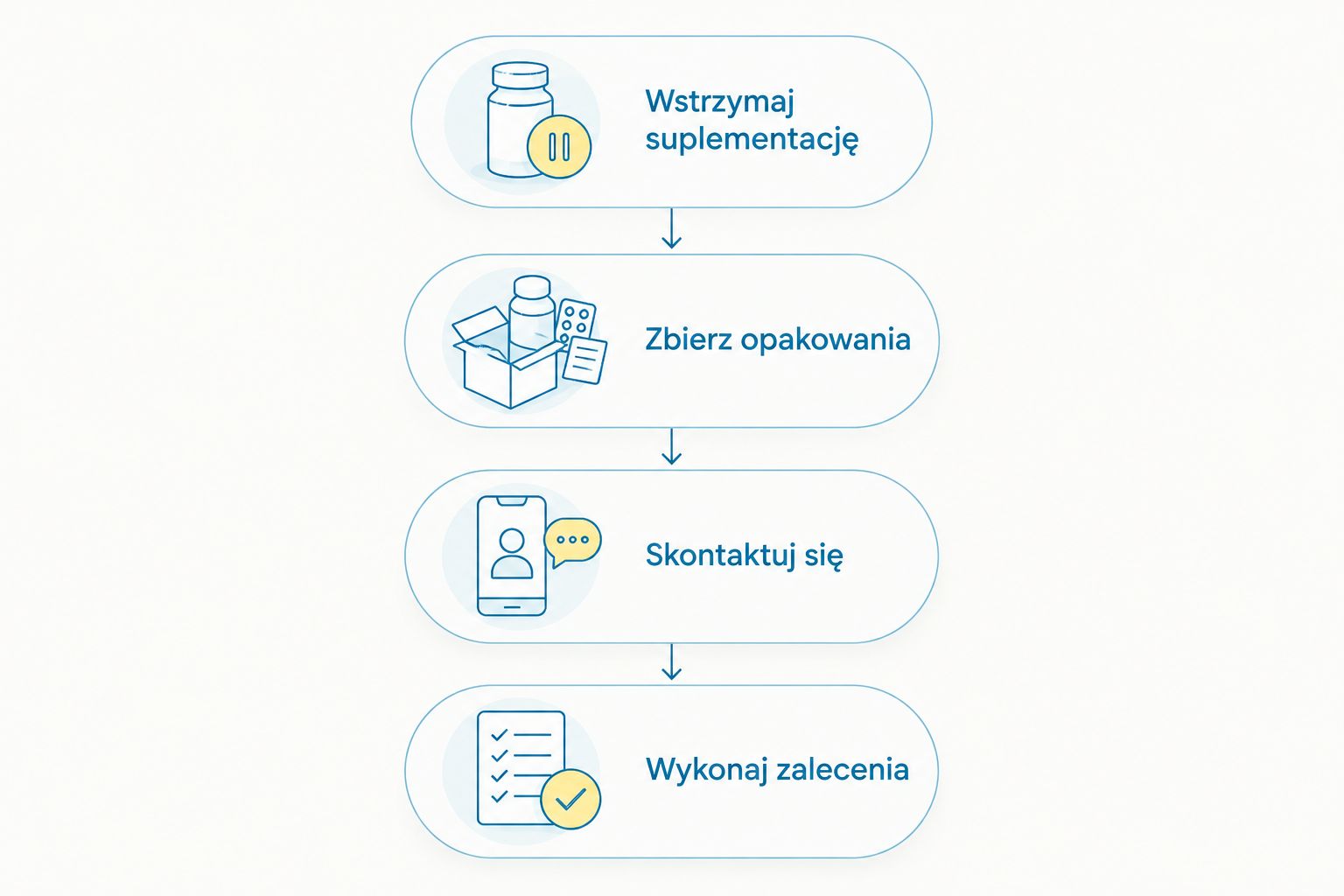
If you suspect an overdose, withhold the next dose of vitamin D and seek medical advice. Do not try to calculate on your own how many days you need to take a break. This calculation does not take into account previous use, calcium levels or kidney function.
- Stop supplements. Do not take another vitamin D or additional calcium supplement until advised. Agree on changes to other medications with your doctor.
- Collect the packages. Prepare the name of the preparation, the amount of vitamin D in the capsule or drops, the number of servings and the time of administration. Take a photo of the label if it's easier to convey.
- Contact your doctor. Tell me about other supplements, kidney disease, medications you're taking, and symptoms you're experiencing. Check if the amount is unknown or the preparation was taken by a child.
- Follow the instructions. The doctor determines the need for tests, observations or treatment. Do not replace this assessment with home remedies.
Do not induce vomiting. Don't take diuretics on your own, don't try to "rinse" the vitamin with huge amounts of water, and don't add K2 as a home antidote. Correct treatment depends on test results and the severity of symptoms.
Why is the risk of overdose different?
There is no single dose that will produce the same effect in every person. The amount of the preparation taken, the duration of use and individual susceptibility are important. Risk assessment in 2026 still requires this information - the number on the front of the package alone is not enough.
- Total amount from all preparations. Vitamin D may be present in a single-ingredient preparation, multivitamin and other complex used in parallel.
- Duration time. One-time mistake and repeated exceeding of recommendations over a long period of time. These are different situations that require separate assessment.
- Concentration and method of measurement. A drop, a portion of a drop and a full pipette do not mean the same thing. Check the instructions for the specific package.
- Comorbidities. Kidney disease, sarcoidosis and some other conditions change the way we evaluate the safety of supplementation.
- Medications and additional calcium. Some medications, including thiazide diuretics, increase the importance of calcium control. Your doctor should know the full list of medications you are taking.
Do not increase your dose due to weight, fatigue or less sun without establishing an appropriate regimen. A symptom suggesting a deficiency is not evidence of a deficiency. Likewise, an improvement in well-being does not confirm that the selected amount is safe for long-term use.
How to check the dose on the label in 2026?
You will find micrograms and international units on the packaging. 1 µg of vitamin D corresponds to 40 IU The IU notation means the same international units; is not a separate dose type.
First determine what the amount given refers to. The manufacturer may indicate the content in a capsule, drop or the entire recommended daily dose. Only then calculate the amount according to how much you actually take.
When checking labels, write down separately:
- the name of each preparation containing vitamin D;
- amount of vitamin D in a single serving;
- number of servings and frequency of use;
- amount of additional calcium, if any you are supplementing.
Do not directly add micrograms to international units. First, reduce all values to the same unit. If the label is illegible or you have doubts about the dropper, show the package to the pharmacist instead of guessing.
The percentage of the reference intake is also not a substitute for individual dosing. A high percentage on the label does not in itself recognize poisoning, and a lower percentage does not confirm the safety of combining multiple products. The most important thing is the actual amount and the recommended regimen.
What tests help assess the excess?
The basic test assessing the body's supply of vitamin D is the determination of 25(OH)D in the blood. If poisoning is suspected, the doctor also assesses calcium levels and kidney function, including on the basis of creatinine. Depending on the situation, he orders additional tests.
The 25(OH)D result alone does not describe the patient's entire condition. Symptoms, calcium levels, intake amounts and comorbidities are important. Do not directly compare results recorded in different units or start treatment based on a table found on the Internet.
Not every healthy adult needs a routine examination before every decision about preventive care. Suspected overdose, however, is a different situation than simply selecting supplements. If a mistake has occurred, do not postpone medical contact until the scheduled check-up.

Does vitamin K2 protect against D3 overdose?
Vitamin K2 does not protect against vitamin D3 poisoning. Its presence in the preparation does not invalidate the limits of vitamin D intake and does not justify increasing the dose on your own. Do not use supplemental K2 as a treatment for suspected hypercalcemia.
If you are considering SUPERSONIC +LABS D3K2 Complex, check the current label for the vitamin D content per serving and include it in your total intake. The advantage of a combined preparation is that the ingredients are taken in one product; limitation - the need to check whether their common dosage meets your recommendations. The combination of D3 and K2 alone does not confirm that the product is appropriate for every person.
When using vitamin K antagonists, such as warfarin or acenocoumarol, do not introduce a K2 supplement yourself. Agree on the change with your doctor. This also applies to replacing the current preparation with a complex with a different composition.
Does a single double dose mean poisoning?
A single double dose does not automatically mean poisoning, but its significance depends on the amount contained in the preparation, age and health condition. Doubling a small preventive dose is not the same as doubling a large therapeutic dose. Do not assess the risk solely by the number of capsules.
Check the packaging and tell the pharmacist or doctor the specific amount and time of intake. If a child has taken the preparation, the dose is unknown or symptoms occur, urgent consultation is needed. Don't wait for your well-being to get worse.
Does excess D3 disappear immediately after discontinuation?
Excess vitamin D3 does not disappear immediately after discontinuation, and calcium metabolism disorders may require further treatment and control. It is impossible to determine a safe day to return to supplementation based on the date of the last capsule alone. The decision is made by the doctor based on the course of the situation and the results.
FAQ
Can you overdose on vitamin D3 with daily use?
Yes, taking too much vitamin D3 every day can lead to poisoning. Add up vitamin D from all preparations and do not increase the recommended dose yourself.
What is the upper limit of vitamin D for adults?
The tolerable upper intake level for adults according to EFSA is 100 µg, i.e. 4000 IU. daily. This is the limit for long-term total oral intake, not the dose recommended for everyone or the threshold for diagnosing poisoning.
How to recognize the symptoms of a vitamin D3 overdose?
Symptoms may include nausea, vomiting, constipation, severe thirst, frequent urination and weakness. They are not sufficient to diagnose poisoning: a medical assessment and appropriately selected tests are needed.
What to do if a child has drank vitamin D3 drops?
Urgently contact a doctor and prepare the packaging and information about the possible amount and time of administration. Do not induce vomiting and do not wait for symptoms; in case of severe deterioration of the condition, call 112.
Does vitamin K2 prevent overdose of D3?
No, vitamin K2 does not prevent vitamin D3 poisoning and is not its antidote. Combined preparations also require control of the total amount of vitamin D intake.
Can you overdose on vitamin D3 from the sun?
Ordinary sun exposure does not cause vitamin D poisoning because the skin regulates its production. Excessive UV radiation is still harmful to the skin and is not a safe way to treat deficiency.
Do I need to take a double dose if I miss a dose of D3?
Don't make up for the missed dose by doubling the next dose yourself. Check the instructions for the preparation, and when considering the treatment regimen, ask your doctor or pharmacist about further steps.
Finally: check the preparations, not only vitamin D
The simplest supplementation review in 2026 start by placing all the packages next to each other. Include immune supplements, multivitamins and occasional products, not just the bottle marked D3. The same ingredient is sometimes written down in several places and in different units.
The best protection against mistakes is one current list of doses. Save it in your phone and show it during a doctor's or pharmaceutical consultation. Information about the amounts you actually take is more useful than just ensuring that you use the preparations according to the labels.
The material is educational and does not replace individual medical advice. Suspected poisoning requires contact with medical staff and not correcting the supplementation yourself.
Related guides


