

Parmesan cheese, chicken breast, pumpkin seeds, peanuts and tofu are high in protein. In the table for 2026, the protein content is from 2.7 to 35.8 g per 100 g of product; When choosing, the portion size and whether you weigh the product raw or prepared also matter.
- What has a lot of protein? Parmesan provides 35.8 g and roasted chicken breast provides 31.0 g per 100 g.
- Firm tofu provides 17.3 g of protein per 100 g; cooked lentils - 9.0 g.
- Compare high-protein products in the same form: dry, raw or ready-to-eat.
- SUPERSONIC Food is a brand of protein meals and drinks for people looking for convenient nutrition.
Why the 100g comparison matters
The common weight allows you to compare protein concentration, but it does not yet show how much you will eat in a meal. 100 g of pumpkin seeds and 100 g of cooked lentils are different portions in terms of volume and composition.
On offer SUPERSONIC Food you will find meals, supplements and protein drinks. When comparing them, use the same rule: first check the values on the label, then convert them into the portion you will actually prepare.
Protein content in products: table per 100 g
Protein content here means the number of grams of protein in 100 g of the edible part of the product, as indicated in the table. The range of the entire list is 2.7–35.8 g/100 g — this is not an average for all foods.
| Product and character | Protein per 100 g | Best use | Limitation in comparison |
|---|---|---|---|
| The whole list | 2.7–35.8 g | Reference point for the following products | Range of selected items, not market average |
| Parmesan, hard | 35.8 g | Adding protein and flavor to dishes | You usually eat less than 100 g of it; include salt |
| Chicken breast, skinless, baked | 31.0 g | Protein base for dinner | The result applies to meat after processing |
| Pumpkin seeds, shelled, dried | 30.2 g | An addition to salads and plant-based meals | High fat content; the portion of the supplement is smaller |
| Peanuts, raw | 25.8 g | A snack or addition to a meal | They contain a lot of fat and are an allergen |
| Chicken breast, skinless, raw | 22.5 g | Calculating protein before preparing dinner | Do not use this value for the mass after baking |
| Almonds | 21.2 g | An addition to breakfast or a snack | They do not replace the main ingredient of the meal in volume |
| Hard tofu, with calcium sulfate | 17.3 g | Vegetable base for dinner | Other types of tofu have different water content |
| Chicken egg, whole, raw | 12.6 g | Protein ingredient for breakfast | The weight refers to the part without the shell |
| Lentils, cooked without salt | 9.0 g | The basis for a soup, salad or plant-based dish | Do not compare this value with dry lentils |
| Chickpeas, cooked without salt | 8.9 g | An addition to dinner or a spread base | The result does not apply to dry grain or ready-made hummus |
| Whole milk, 3.25% fat | 3.2 g | Ingredient for a drink or breakfast | You will get more protein from a larger serving |
| Broccoli, raw | 2.8 g | Vegetable ingredient of a meal | Don't use it as your main source of protein |
| Long grain white rice, cooked | 2.7 g | Carbohydrate part of dinner | It needs a separate, more concentrated source of protein |
Parmesan has the highest protein content in this ranking: 35.8 g/100 g; cooked rice closes the table with 2.7 g/100 g. Baked chicken breast provides 31.0 g/100 g, and among the plant products shown, dried pumpkin seeds have the highest content - 30.2 g/100 g.
Source: USDA FoodData Central, SR Legacy collection, April 2018 issue; the data refer to general food products in the forms listed, and the values are rounded to one decimal place. The 2026 list does not describe specific brands, so the label of the purchased product is the correct basis for calculating your portion.
How to use the table in 2026
- Choose the base of your meal, not just the highest score. Roasted chicken has 31.0 g/100 g, but Parmesan cheese, at 35.8 g/100 g, usually acts as an addition.
- Match the form of the product to weighing. For raw chicken breast use 22.5 g/100 g; for baked - 31.0 g/100 g.
- Calculate the actual portion. Tofu with a score of 17.3 g/100 g will provide approximately 34.6 g of protein in a 200 g serving.
- Don't skip supplemental ingredients. Lentils have 9.0 g/100 g, but in addition to protein, they also provide fiber; pumpkin seeds also contain fat.
The table helps you choose an ingredient. It does not replace the balance of the entire day or the assessment of whether the meal contains vegetables, the right amount of energy and products that you tolerate well.
How much protein does your serving have?
The simplest formula is: protein per serving = serving weight in grams × protein per 100 g ÷ 100. Use the product weight in the same form as the value in the table or label.
For example, 150 g of baked chicken breast provides approx 46.5 g of protein. A serving of 200 g of cooked lentils gives approx 18.0 g, and 30 g of pumpkin seeds - approx 9.1 g; are calculations based on rounded values from the table.
The choice is therefore less obvious than the order of the lines suggests. Seeds have significantly more protein per 100g than lentils, but a serving of lentils can provide more protein than a small sprinkle of seeds.
Weigh the product consistently. If you log the weight of the chicken before roasting, do not choose the item described as roasted meat - otherwise you will inflate the calculated result.
Raw, dry and cooked: what are the differences?
Processing changes the amount of water in the product, and therefore the concentration of ingredients per 100 g. Meat loses water during baking, while dry legumes absorb it during cooking.
The table has raw chicken breast 22.5 g of protein/100 g, and baked 31.0g/100g. A higher result after baking does not mean that the processing produced additional protein; the proportion of protein to product mass has changed.
These values describe different items in the database, not a measurement of one piece of meat before and after cooking. Don't use them to determine the exact weight loss in your kitchen.
Do the same with legumes and rice. When weighing cooked lentils, use the data for cooked lentils, not the information from the dry produce package; when canning, check that the label describes the product after draining.
How to check a product before adding it to your menu
In 2026, compare labels in one order. Thanks to this, you will not combine dry conditioner with a ready-made drink or a small snack with a full dinner.
- Product form: determine whether the data concerns a powder, a raw product, a cooked product or a finished drink.
- Serving weight: check how much you actually eat or drink, instead of automatically taking 100 g.
- Protein per serving: convert the value from the label, taking into account the ingredients added during preparation.
- Whole meal: also assess energy, fat, carbohydrates, fiber and salt.
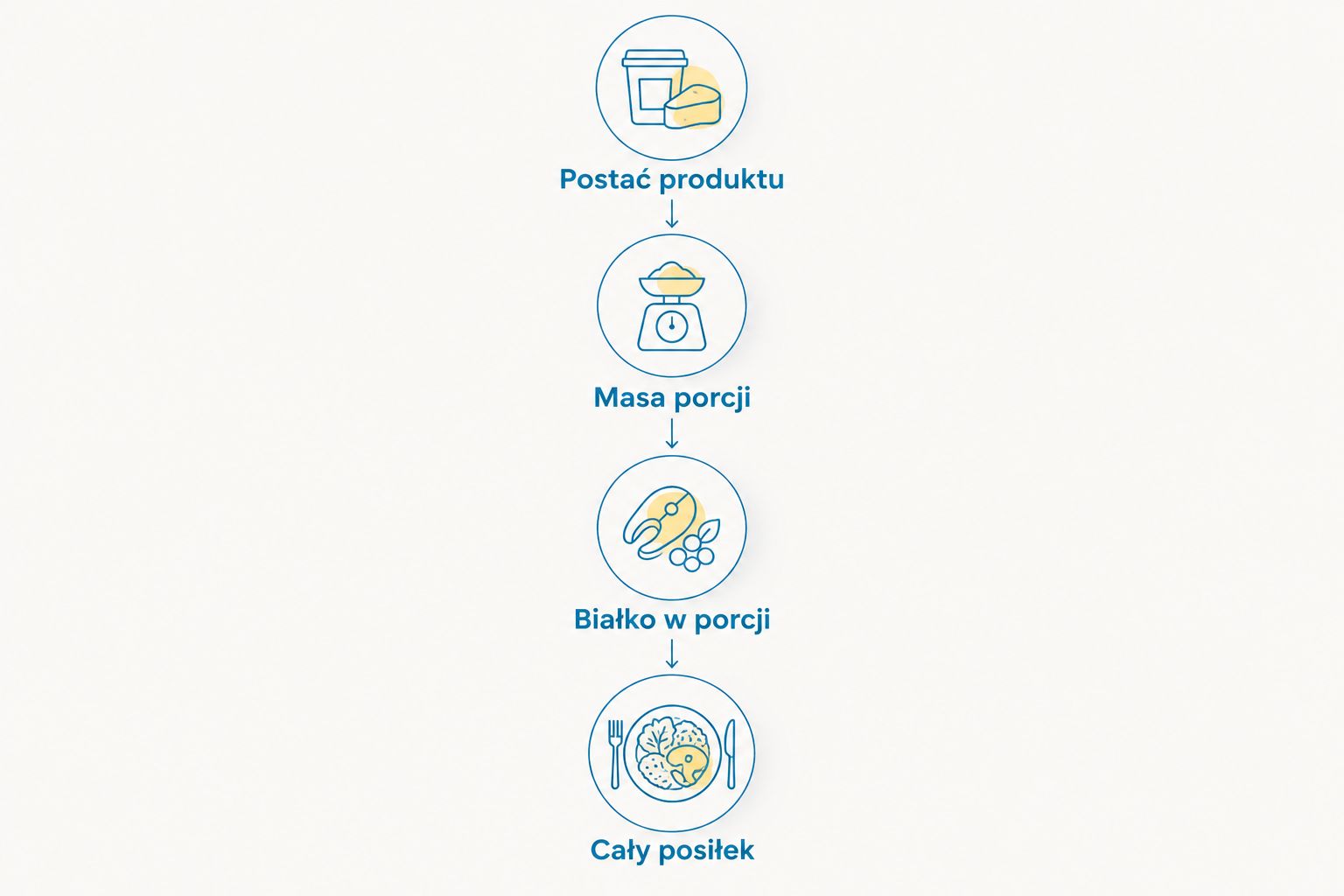
This sequence works for regular foods and protein products. If you prepare the powder with milk, count the protein from the powder and milk separately; water adds bulk to the drink but does not add protein.
What's high in protein in a plant-based diet?
Among the products from the table, pumpkin seeds provide 30.2g/100g, peanuts 25.8g/100gand almonds 21.2g/100g. These are concentrated sources of protein, but they also contain a lot of fat, so don't judge them solely by one column.
For the base of a plant-based dinner, choose tofu or legumes; Treat seeds and nuts as a supplement. Firm tofu from the table has 17.3 g/100 g, cooked lentils 9.0 g/100 g, and cooked chickpeas 8.9 g/100 g.
The advantage of legumes is the combination of protein and fiber. The limitation is the lower concentration of protein than in roasted meat and the tolerance of larger portions - increase their proportion according to the reaction of your digestive system.
Tofu is a convenient base for many dishes, but its composition depends on the type and manufacturer. Don't transfer the result for firm tofu to silken tofu; You can read more about the selection of ingredients in the guide o high-protein products for vegetarians.
What to choose for breakfast, for work and for dinner?
For breakfast, choose a protein component instead of relying only on bread or side dishes. Eggs have 12.6 g of protein/100 g of the edible part, and hard tofu from the table has 17.3 g/100 g; you can combine both products with vegetables and other breakfast ingredients.
Choose a meal for work whose composition and portion can be easily assessed. Lentils or chickpeas can be the base of a salad, but a small sprinkle of seeds does not replace a larger portion of protein.
For dinner, consider rice as the carbohydrate part. Its 2.7 g protein/100 g does not make it a primary source of protein; add chicken, tofu or legumes instead of trying to get the whole result by increasing the amount of rice.
The rule of thumb is simple: first choose a protein base, then choose vegetables and other ingredients. Thanks to this, protein will not be an accidental addition to the meal.
Does the supplement or shake replace regular food?
Protein supplement is used to supplement protein, but the name itself does not mean a complete meal. A shake also requires an assessment of its composition: protein is only one element, along with energy, fat, carbohydrates and other ingredients.
SUPERSONIC Food offers protein meals and drinks for people who need convenient nutrition during the day. The advantage of this category is convenience; limitation - the need to check whether a specific product suits the role of a snack, protein supplement or meal.
For SUPERSONIC Food products, use the label of the selected variant, not the general food table. Compare the portion after preparation and take into account additives, instead of transferring the result per 100 g of powder directly to the finished drink.
Protein on reduction: the result in the table is not everything
High protein content does not automatically mean low energy value. Pumpkin seeds, almonds and Parmesan cheese have their place in the menu, but they also provide fat; the highest result per 100 g does not determine which product best suits your portion.
When cutting, compare protein with energy and meal size. Don't choose a product just because it has more protein than the next item in the table. What matters is the entire menu and whether you can stick to it in practice.
Also, do not determine your protein needs based on this list. The 2026 table describes food, not an individual nutritional goal; If you have kidney disease or other medical restrictions, discuss your protein intake with your doctor or dietitian.
The most common mistakes when counting protein
- Confusing 100 g with a serving. The package, handful and portion listed on the label do not have to weigh the same.
- Counting eggs with shell. The value in the table applies to the edible part, so the shell should not increase the recorded weight.
- Skipping the milk in your shake. Milk provides additional protein, but water does not.
- Transferring data between products. Firm tofu, silken tofu and ready-made tofu dishes do not have the same composition.
- Treating creatine as a protein. Creatine does not replace the source of protein in a meal.
Record the weight and form of the product together. A short note like "baked chicken" or "boiled lentils" helps avoid a larger error than an extra decimal place in the calculation.
FAQ
What has a lot of protein per 100 g?
Parmesan has the most protein in this combination: 35.8 g/100 g. Baked chicken breast provides 31.0 g/100 g, and dried pumpkin seeds 30.2 g/100 g; compare the result with the actual portion size.
What has a lot of protein without meat?
Without meat, sources of protein include tofu, lentils, chickpeas, seeds and nuts. Firm tofu from the table provides 17.3 g/100 g, and cooked lentils 9.0 g/100 g; the type of product and preparation change the result.
How much protein does chicken breast have?
In the table, raw chicken breast without skin has 22.5 g of protein/100 g, and baked breast has 31.0 g/100 g. For calculations, choose the value corresponding to the form in which you weigh the meat.
Why does a cooked product have a different protein content?
Cooking and baking change the amount of water, and therefore the protein concentration per 100 g. Meat loses water during baking, while dry legumes absorb it during cooking.
How to calculate the protein in your serving?
Multiply the serving weight in grams by the protein content per 100 g and divide the result by 100. With 200 g of tofu containing 17.3 g of protein/100 g, you will get approximately 34.6 g of protein.
Are nuts a good main source of protein?
Nuts provide protein, but are usually better as a supplement to a meal. They also have a lot of fat, so a high result per 100 g does not mean that a small handful will replace a portion of tofu or legumes.
Is a protein shake enough instead of dinner?
The protein content alone is not enough to consider a shake a complete lunch. Check the energy, fat, carbohydrates and other ingredients and match the product to the entire menu.
Does creatine increase the amount of protein in a meal?
No, creatine is not a substitute for dietary protein. Use food and protein information on labels to balance protein.
Finally: The winner of the table doesn't have to win at the plate
Portion is more important than first place on the list. For example, 20g of Parmesan cheese provides approximately 7.2g of protein, while 200g of cooked lentils provides approximately 18.0g - despite lentils having a much lower score per 100g.
Using the table in 2026, start with one meal. Weigh its main protein ingredient, choose the appropriate form of the product and calculate the portion; only then decide whether you need additional protein.
Related guides


