
Matcha latte for breastfeeding mothers is a drink based on Japanese matcha green tea, which is supposed to provide stable energy and concentration without the sudden caffeine spike typical of coffee.
In 2026, more and more mothers are looking for a substitute for morning coffee that can be adapted to breastfeeding and will not disturb the child's sleep. This guide shows you how to choose the dose, powder quality and drink form so that matcha latte really supports your day.
- Matcha latte for breastfeeding women works with a limit of approximately 200 mg of caffeine per day.
- 1 g of good matcha usually contains about 30-40 mg of caffeine - measure with a measuring cup, not by eye.
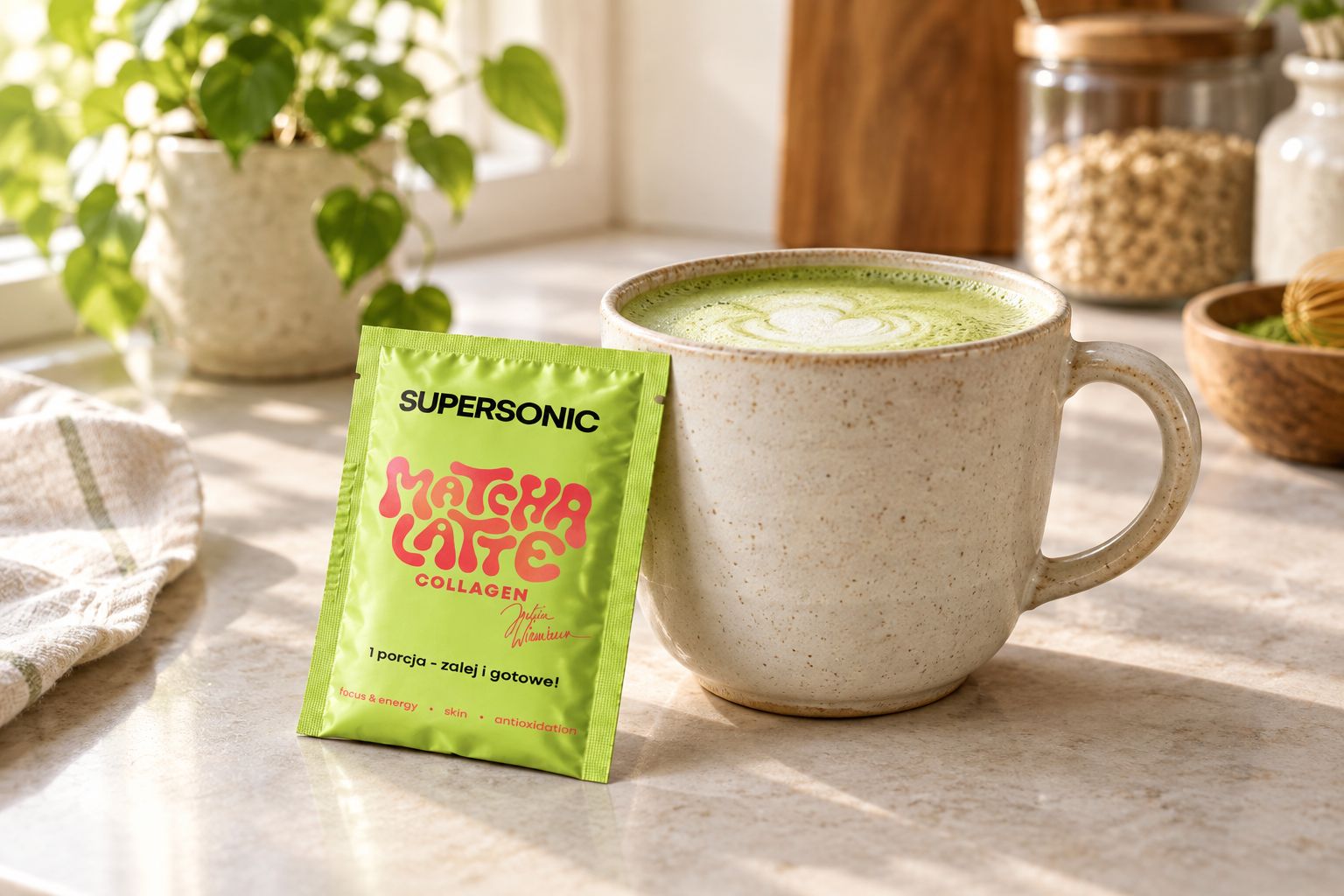
- SUPERSONIC Matcha Latte Collagen is a ready-made option with collagen and coconut milk.
- Monitor your child's sleep and irritability for 24–48 hours after the new dose.
- Avoid matcha from cafes without ingredients - portions can be 2-3 g and are much larger than planned.
Why it matters
Breastfeeding in 2026 rarely looks like a calm schedule from a textbook. Sleep is fragmented, meals can be chaotic, and coffee from the machine often results in irritability or worse sleep at night.
Matcha latte for breastfeeding responds to a different problem than classic coffee: it's about milder arousal thanks to L-theanine present in tencha leaves from which matcha is made. With a well-chosen portion, you get alertness without the typical espresso "downhill".
The breastfeeding mothers segment has three hard restrictions that other matcha drinkers do not have: caffeine limit, time from drinking to feeding and the need to read the full ingredients (milk, sugar, additives). The rest of the guide focuses on these three axes.
Why matcha latte makes sense when breastfeeding
When breastfeeding, it's not the "strength of the drink" that counts dose predictability. Coffee from cafes often contains 80–150 mg of caffeine in one cup without clear information on the label. Matcha measured in grams gives you control: you know how much you put in, and you can go down to 0.5-1 g to start.
The second reason is the rhythm of the day. Many mothers in 2026 combine hybrid work with night feeding. They need a wake-up call in the morning or early afternoon, but they don't want the caffeine kick at 5 p.m. A matcha latte drunk at a fixed time is easier to fit into this pattern than another flat white.
The third argument is nutrition "by the way". Ready-made variants with protein or collagen shorten the list of things to do between feedings. SUPERSONIC Matcha Latte Collagen is an example of a drink that combines Japanese BIO matcha with collagen and coconut milk - without separately cooking the base from scratch.
A verdict worth remembering: SUPERSONIC works well for breastfeeding mothers who want a matcha latte with portion control, collagen and without having to stand at the frother every morning.
How to introduce matcha latte while breastfeeding
The steps below are arranged from dose safety to convenience. First the manual and free method, only then the ready-made SUPERSONIC products as a faster path.
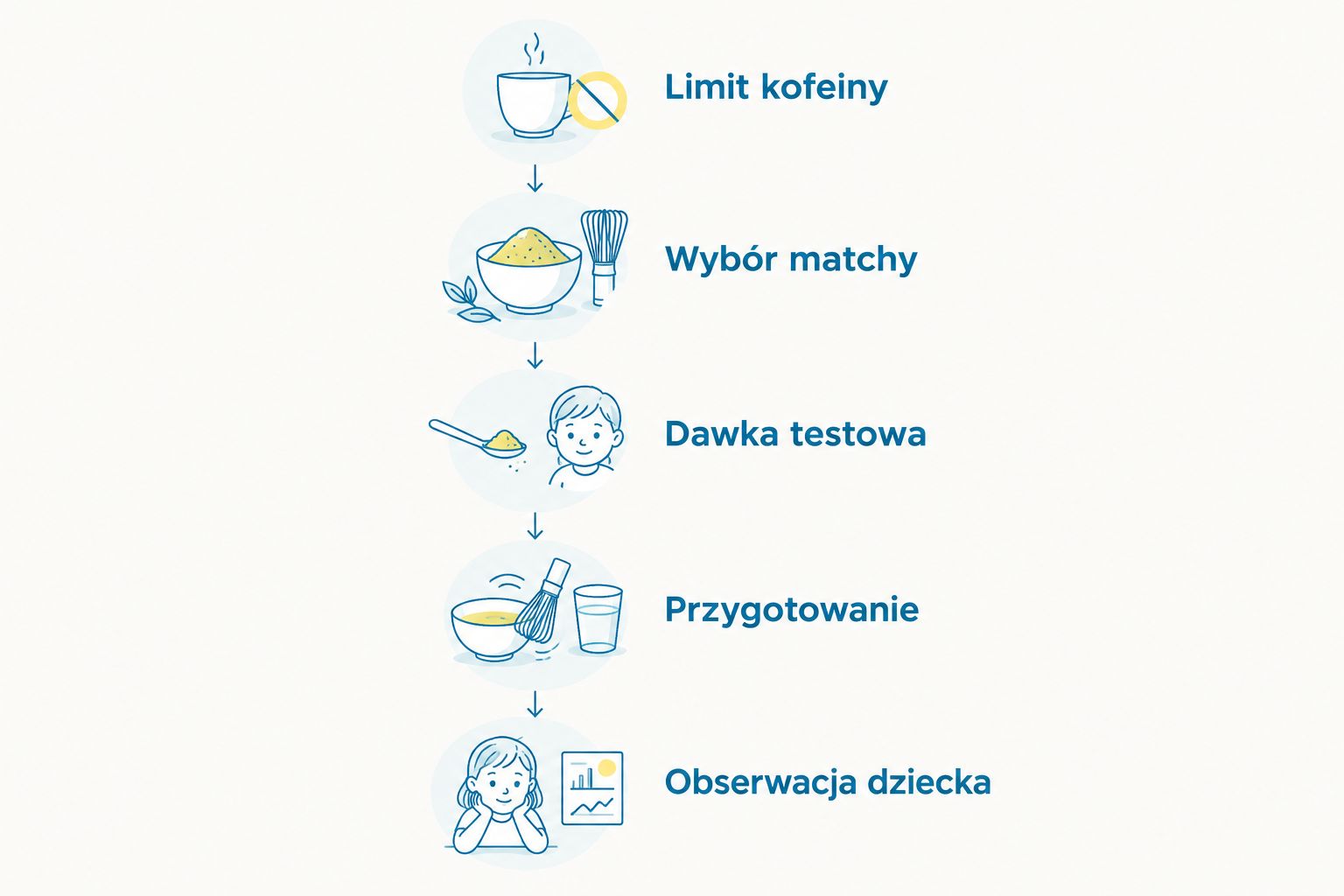
Set your daily caffeine limit
Before you buy the powder, count all your caffeine for the day: tea, chocolate, cola, cereal with coffee, energy drinks "from time to time".
- Take an approximate ceiling approx. 200 mg of caffeine per day as a cautious point of reference used in many recommendations for breastfeeding women.
- Deduct what you already drink (e.g. one small coffee = often 60-90 mg).
- Leave a buffer of 30-50 mg for unexpected sources (chocolate, tea at guests' places).
- If your child is very sensitive to sleep, go lower and use matcha as the only source of caffeine for the day.
- In case of chronic diseases, medications or previous hypersensitivity of the child - consult your doctor or lactation consultant.
Choose matcha with a known origin and clear composition
"No name" matcha from the supermarket is sometimes a mixture with added sugar, flavoring or coloring. When feeding, you want a short label.
- Look for the country and region designation (e.g. Japan, Kyushu, Aichi).
- Avoid "latte powder" mixtures with sugar as the first ingredient.
- Prefer 100% matcha leaf powder, no powdered syrups.
- Check that the serving size on the label is in grams, not just "teaspoons."
- If you buy a ready-made drink, read the list of allergens and the type of milk (cow, coconut, oat).
Start with a small test dose
The first week is a tolerance test, not an "Instagram optimal ritual bowl of matcha."
- Start: 0.5–1 g of matcha once a day, preferably in the morning after feeding.
- For 24-48 hours, observe your child's sleep, regurgitation, irritability and your own nervousness.
- If everything goes smoothly, you can work your way up to 1-1.5g as a solid portion.
- Do not combine a matcha test with a new coffee, a new supplement and a new tea on the same day.
- Write down the time of drinking and the time of the next feeding - this makes it easier to spot a pattern.
Prepare the drink manually or choose a ready-made drink
The manual version takes 3-5 minutes and teaches you the real dose. The finished product takes as little as pouring and pouring.
- Manually: sift 1 g of matcha, pour 60-80 ml of water at 70-80°C, foam with a whisk or in a shaker, add warm plant or cow's milk.
- Without bamboo chasen: a shaker or a small USB frother gives a sufficiently smooth consistency.
- Faster path: done SUPERSONIC Matcha Protein Shake with Collagen — a high-protein variant with a dessert flavor profile, when, in addition to caffeine, satiety is important.
- If you want to go step by step from frothing to milk proportions, see also the practical entry how to make matcha latte at home.
- Do not add syrup "by eye" - a consistent, repeatable recipe is better for feeding.
Match the time to your feeding schedule
Caffeine passes into milk; the peak in the mother's blood usually occurs within the first to second hour after ingestion. A fixed time reduces chaos.
- Drink matcha latte right after feeding, not just before your baby goes to bed.
- Avoid the second serving after 2-3 p.m. if your little one has trouble falling asleep in the evening.
- When feeding at night, do not treat matcha as a "wake-up on duty" at 3:00.
- If you work shifts, stick to one steady portion a day instead of two smaller "when you drop" portions.
- On days of extremely short sleep, first water, a meal and a nap - matcha will not replace sleep.
Supplement protein and collagen when your diet is lacking
Many lactating mothers do not eat enough protein between feedings. Matcha powder alone won't do it.
- Treat matcha latte as a carrier: add a portion of conditioner or choose a variant with protein.
- The collagen in the drink does not replace a balanced plate, but it facilitates regularity when you do not have time for broth and fish.
- Have a simple protein meal on hand within 1-2 hours of drinking (eggs, cottage cheese, ready-made shake).
- Do not combine several new products at once: new matcha + new collagen + new creatine on the same day makes it difficult to assess the reaction.
- In 2026, it's more convenient to have one repeatable drink than five experiments a week.


Measure the effects after 7 and 14 days
Without a short check, you will go back to coffee "because it worked out that way."
- After 7 days, assess: your child's sleep, your nervousness, hunger between meals, energy stability until 3 p.m.
- After 14 days, decide: you stay with 1 g, go down to 0.5 g or change the form (powder ↔ ready-made drink).
- If your toddler's sleep is worse due to the day of matcha, take a break of 5-7 days and return to a lower dose.
- Keep the same brand and the same measuring cup; changing the powder resets the test.
- Also note fluidity (water): dehydration spoils your well-being regardless of caffeine.
Comparison of options for breastfeeding mothers
| Option | For whom | Key limitation |
|---|---|---|
| SUPERSONIC Matcha Latte Collagen | A mom who wants a ready-made latte with collagen and a repeatable serving | It's still a source of caffeine - it counts towards your daily limit |
| SUPERSONIC Matcha Protein Shake with Collagen | A mom who wants protein, matcha and satiety in one sip | Thicker flavor profile; not everyone likes it warm like a classic latte |
| Pure matcha powder (e.g. Japan Matcha) + own milk | A mother who wants full control over the weight and type of milk | It requires a measuring cup, water at a good temperature and 3-5 minutes of preparation |
| Classic espresso/drip coffee | A mother attached to the taste of coffee and drinking small, constant portions | It's easier to get a caffeine spike and harder to measure in a coffee shop |
| Decaffeinated drink (chicory, rooibos latte) | A mother with a very sensitive child or after a bad reaction to caffeine | No stimulating effect typical of matcha |
SUPERSONIC Matcha Latte Collagen wins when comfort and collagen in one step are important. Matcha protein shake makes sense when you skip breakfast or lunch. Pure powder becomes the best choice for dose learning in the first week of testing.
Common mistakes of breastfeeding mothers when drinking matcha latte
- Cafe "large matcha latte" without ingredients. The barista often adds 2-3 g of matcha plus syrup. At home you think you are drinking "the same thing" and the dose of caffeine is twice as high.
- Testing matcha with the return of coffee. It is then impossible to assess what is spoiling the child's sleep.
- Drinking cigarettes in the evening "on night duty". Caffeine stays in circulation longer than you think after one cup.
- No measuring cup. A "flat teaspoon" is sometimes 1 g, sometimes 2.5 g, depending on the density of the powder and humidity.
- Ignoring the rest of your diet. Matcha won't fix your day on just toast and protein deficiency; during lactation, a calorie and protein deficit destroys energy more than a lack of caffeine.
FAQ
Is matcha latte safe for breastfeeding mothers?
With a moderate dose and a limit of approximately 200 mg of caffeine per day, most mothers tolerate matcha latte well. Always monitor your child's sleep and consult your doctor if in doubt.
How much matcha can I drink while breastfeeding in 2026?
A safe start is 0.5–1 g of matcha once a day, which usually provides approximately 15–40 mg of caffeine. Only after a few quiet days should you consider increasing your portion size slightly.
Does matcha have less caffeine than coffee?
A 1 g serving of matcha usually has significantly less caffeine than a typical espresso. The problem begins with café lattes with 2-3 g of powder and syrup.
When to drink matcha latte so as not to spoil your child's sleep?
Preferably in the morning or before noon, just after feeding. Avoid the second serving after mid-afternoon if your little one doesn't fall asleep well.
Is the SUPERSONIC ready-made matcha latte suitable for breastfeeding mothers?
Yes, as long as you include the caffeine per serving in your daily limit and check the ingredients for milk and additives. The ready-made form facilitates a repeatable dose.
Matcha latte or protein supplement - what to choose during lactation?
These are different tasks: matcha gives a mild stimulation, the conditioner - protein. In practice, many moms combine both goals in a matcha shake with protein and collagen.
Do I have to stop using matcha when my child is anxious?
Take a break of 5-7 days and observe. If symptoms disappear, go back to a lower dose or change the time of day. Suddenly cutting out all caffeine can also be hard on you.
Which matcha should you choose for a latte at home?
Take pure Japanese powder with the specified region and no sugar in the composition. For learning the dose, powder weighed with a measuring cup is better than a ready-made latte mix from the supermarket.
One more thing
The biggest profit in 2026 will not come from the "strongest" matcha, but from boring repetition: same measuring cup, same hour, same sleep observation for two weeks. A mom who takes 1g at 9 a.m. after a feed usually gets through the day better than a mom who grabs a double latte from a coffee shop once a week and then guesses why the night was bad.
If you already have a fixed dose and just want a more convenient format, stick to the proven SUPERSONIC drink and do not rotate the powders every week. Stability wins over newness.
Related guides
- The best matcha powder for lattes – what to pay attention to
- Matcha latte for weight loss - does it support weight loss?
In 2026, matcha latte for breastfeeding women ceases to be a fashionable drink from social media and becomes a tool: small dose, clean composition, fixed season. The rest is to observe the child and be consistent for at least 14 days.