

People with hypothyroidism or Hashimoto's disease often report similar symptoms: dry, sagging skin, hair loss, joint pain, swelling of the face and hands, and slow wound healing. The standard explanation is "slowing down the metabolism." But behind many of these symptoms there is a specific biochemical mechanism that is rarely named directly: disturbance of collagen synthesis and degradation. Collagen and the thyroid gland are a combination that is not talked about much in popular articles about Hashimoto's disease. And it is worth attention because it explains where the skin and joint symptoms come from in patients who have balanced TSH and still feel "off".
How do thyroid hormones regulate collagen metabolism?
Thyroid hormones, primarily triiodothyronine (T3), act at the cellular level as regulators of gene expression. Fibroblasts, i.e. cells that produce collagen, have receptors for T3. When T3 is at the appropriate level, fibroblasts actively synthesize procollagen, which is transformed into mature collagen fibers. When T3 levels drop, which happens in hypothyroidism, fibroblast activity decreases. Collagen synthesis slows down. At the same time, the balance between collagen-building (prolidase) and collagen-degrading (metalloproteinases) enzymes is disturbed. The result is a gradual deterioration of the quality of connective tissues. Research confirms this relationship at the biochemical level. In hypothyroidism it is observed decreased concentration of hydroxyproline in urine, a marker of collagen turnover, which indicates reduced synthesis and remodeling of collagen in tissues.
Hypothyroidism and skin: what happens to collagen?
One of the classic symptoms of untreated hypothyroidism is myxoedema, i.e. characteristic skin swelling resulting from the accumulation of glycosaminoglycans (hyaluronic acid, chondroitin sulfate) in the dermis. This is not typical swelling due to excess water, but a change in the structure of the extracellular matrix, in which collagen is the main component. The skin in hypothyroidism is dry because the sebaceous and sweat glands work slower. It is flaccid and thickened at the same time, because collagen is produced in a changed proportion of types and is less organized. Wound healing is slow because fibroblasts need T3 for effective proliferation and collagen synthesis at the site of damage.
Hashimoto and collagen: does autoimmunity matter?
Hashimoto's disease is an autoimmune thyroiditis in which the immune system attacks the gland tissue. This gradually leads to hypothyroidism, but the mechanism of influence on collagen is two-pronged. Firstly, chronic inflammation characteristic of Hashimoto's disease, it activates metalloproteinases (MMPs), collagen-degrading enzymes. Patients with active Hashimoto's disease and elevated antibodies (anti-TPO, anti-TG) may experience faster collagen loss even with balanced TSH, due to the inflammatory background. Secondly, T3 deficiency at the tissue level is a problem even with "normal" TSH. Some patients with Hashimoto's thyroiditis have impaired conversion of T4 to T3 in peripheral tissues. This means that the thyroid gland is producing T4 (as measured by TSH), but the cells are not receiving enough active T3. Fibroblasts "don't know" to produce collagen, even though laboratory results appear to be normal.

Joint symptoms in thyroid diseases - the role of collagen
Joint pain and morning stiffness are reported by a significant proportion of patients with hypothyroidism and Hashimoto's disease. Some of these symptoms result directly from disorders of collagen metabolism in joint cartilages and ligaments. Articular cartilage is an avascular tissue, strongly dependent on the efficient synthesis of collagen by chondrocytes. With T3 deficiency, chondrocytes work slower, the synthesis of collagen and proteoglycans decreases, and cartilage loses its elasticity and resistance to compression. This may explain why joint symptoms in patients with Hashimoto's thyroiditis often precede confirmation of the diagnosis or persist despite TSH control.
Hair loss and collagen in Hashimoto's disease
Hair falls out in hypothyroidism for several reasons at once. Thyroid hormones regulate the growth cycle of hair follicles, and when they are deficient, the growth phase (anagen) is shortened. But there is also a collagen component: connective tissue sheath of the hair follicle it is made of collagen, and its degradation during chronic inflammation leads to permanent damage to the follicle. Therefore, in patients with Hashimoto's hair loss, hair loss often does not disappear completely after TSH correction. Part of the problem lies in the damaged connective tissue around the follicle, the reconstruction of which requires time and appropriate substrates.
Does collagen supplementation make sense for Hashimoto and hypothyroidism?
This question requires a precise answer. Collagen supplementation does not cure hypothyroidism or Hashimoto's disease, and does not replace levothyroxine, diagnosis or treatment recommended by a doctor. However, it can be an element of everyday support for the body, especially when you care about your skin, hair, nails, connective tissue and well-planned care from the inside. With Hashimoto's disease and hypothyroidism, many people notice dry skin, hair that is more susceptible to weakening, slower regeneration and a general feeling of sluggishness of the body. Collagen does not solve the cause of these symptoms, but it provides collagen peptides and amino acids such as glycine, proline and hydroxyproline, which the body uses in natural processes related to connective tissue. Therefore, it is worth treating it as a supplement to your routine, not as a replacement for treatment.
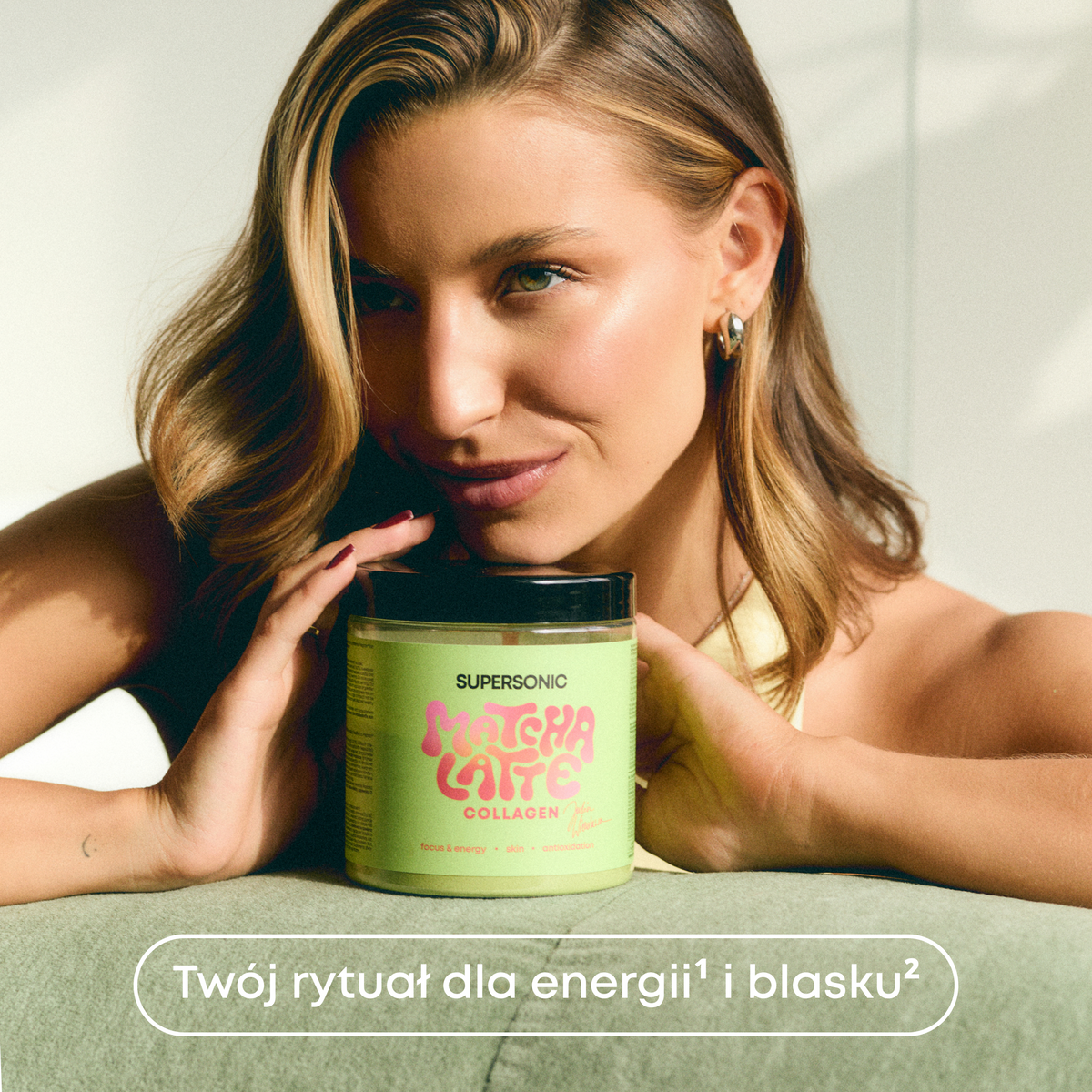
The quality of the formula itself is also important. In the case of people with hypothyroidism, attention is often paid to digestive comfort, intestinal regularity and effective absorption of nutrients. Therefore, it is better to choose collagen that is not based solely on a simple hydrolyzate, but also takes into account bioavailability, microbiome support and ingredients that help protect the skin against oxidative stress. SUPERSONIC Beauty Collagen Drink combines three complementary forms of fish collagen: Peptan®, Verisol® i Liposovit®. Peptan® provides high-quality collagen peptides, Verisol® supports areas related to skin, elasticity and wrinkles, and Liposovit® uses liposomal technology developed for bioavailability. This is a formula that focuses not only on the dose of collagen, but on the entire mechanism of its use. The composition also includes LactoSpore®, i.e. a stable probiotic that supports the intestinal microbiome. This is important because the intestines participate in the digestion and absorption of nutrients, including amino acids, vitamins and polyphenols. They complement the formula hyaluronic acid, supporting the area of skin hydration and comfort, VinOmerix®, grape seed extract rich in polyphenols, and vitamin C from wild rose, which supports the proper production of collagen. In the case of Hashimoto's thyroiditis and hypothyroidism, well-conducted therapy, regular examinations and individual recommendations from a specialist remain key.
Collagen may be a reasonable addition to such a routine if you care about the quality of ingredients, thoughtful bioavailability and support of the skin from the inside. It is also worth remembering the interval between supplements and thyroid medications, as recommended by your doctor or pharmacist.
What is worth knowing before reaching for collagen for Hashimoto's disease?
Some practical notes:
- Balance TSH and T3 first. Collagen supplementation works best when thyroid hormones are at optimal levels, because they activate fibroblasts to work.
- Check your vitamin D and iron levels. Both deficiencies are common in Hashimoto's disease and can inhibit collagen synthesis independently of the thyroid gland.
- Don't expect results within a week. Reconstruction of connective tissue in the case of chronic hormonal disorders is a process that takes months.
- Pay attention to the composition. Fish (marine) collagen is more frequently tested for bioavailability than beef collagen. Avoid products with a long list of fillers.
The thyroid gland as a regulator of collagen throughout the body
The thyroid gland affects collagen not through one, but through many mechanisms at the same time: it regulates the activity of fibroblasts and chondrocytes, influences the enzymes of collagen synthesis and degradation, and shapes the quality of the extracellular matrix of the skin, joints and connective tissue. Therefore, the skin and joint symptoms of Hashimoto's thyroiditis are not a decoration of the disease, but a direct result of collagen metabolism disorders. Understanding this mechanism can help patients explain symptoms that persist despite balanced TSH and direct supplementation where it makes sense.
FAQ
Does hypothyroidism cause skin to age faster?
Yes, indirectly. T3 deficiency slows down the activity of fibroblasts and collagen synthesis in the skin, which accelerates the loss of skin elasticity and hydration. A characteristic symptom is myxoedema, i.e. skin swelling associated with disruption of the structure of the extracellular matrix.
Will collagen supplementation help with Hashimoto's hair loss?
It can be a supporting element, but not the only one. Hair loss in Hashimoto has many causes: disturbed follicle cycle, inflammation and degradation of the connective tissue sheath. Collagen can support the reconstruction of this sheath, but the basis is the treatment of the underlying disease.
Why do my joints hurt even though my TSH is balanced?
In Hashimoto's disease, joint symptoms may persist despite normal TSH for several reasons: T3 deficiency at the tissue level despite normal T4, chronic inflammation activating MMPs and degrading collagen in cartilage, as well as connective tissue damage that requires time and building substrates for reconstruction.
Can collagen worsen Hashimoto?
There is no data showing that collagen supplementation may worsen Hashimoto's disease or autoimmune reactions. Fish collagen is a protein digested into peptides and amino acids, which should not stimulate an immune response directed at the thyroid gland.
What form of collagen should you choose for hypothyroidism?
In hypothyroidism, where intestinal absorption may be reduced, the bioavailability of the collagen form is particularly important. Low molecular weight (peptide) hydrolysates are absorbed better than non-hydrolyzed collagen. Liposomal technology additionally protects collagen during digestion and increases transport to tissues.
Are Hashimoto's thyroiditis and hypothyroidism the same thing?
Hashimoto's is an autoimmune disease in which the immune system attacks the thyroid gland. Hypothyroidism is a condition of deficiency of thyroid hormones and is the most common result of Hashimoto's disease. You can have Hashimoto's disease without hypothyroidism (in the early stages) or hypothyroidism due to another cause.
Sources
Haugen BR, Drugs that suppress TSH or cause central hypothyroidism, Best Practice and Research Clinical Endocrinology and Metabolism, 2009. pubmed.ncbi.nlm.nih.gov/19942154/
Chopra IJ, Euthyroid sick syndrome: is it a misnomer?, Journal of Clinical Endocrinology and Metabolism, 1997. pubmed.ncbi.nlm.nih.gov/9024211/
Zhong Z, Wheeler MD, Li X et al., L-Glycine: a novel antiinflammatory, immunomodulatory, and cytoprotective agent, Current Opinion in Clinical Nutrition and Metabolic Care, 2003. pubmed.ncbi.nlm.nih.gov/12589194/
Shoulders MD, Raines RT, Collagen Structure and Stability, Annual Review of Biochemistry, 2009. pubmed.ncbi.nlm.nih.gov/19344236

Looking for a nutritious and filling meal?
Discover Supersonic Smart Meal! A nutritious meal you can prepare in seconds!


