

Menopause is the moment when changes in the skin, joints and connective tissue accelerate rapidly. It doesn't happen gradually, as it does throughout adulthood, but in leaps and bounds. Women often describe it as "I suddenly started looking different" or "my knees started hurting literally every year." There is one main mechanism behind this jump: loss of estrogen and its effect on collagen metabolism. The answer to the question "what collagen for menopause" is not the same as for a 30-year-old woman who wants to prevent wrinkles. What is at stake here is the inhibition of the real, biologically accelerated decomposition of connective tissue.
Estrogen and collagen: why is it a key relationship?
Fibroblasts, collagen-producing cells, have estrogen receptors. Estrogen acts as an activation signal: it stimulates the synthesis of procollagen, inhibits the activity of collagen-degrading metalloproteinases (MMPs) and supports skin hydration by regulating the synthesis of glycosaminoglycans. As estradiol levels decline during perimenopause and menopause, fibroblasts receive an increasingly weaker signal to produce. Collagen degradation by MMP enzymes is no longer balanced by new synthesis. The balance becomes negative. A classic study by Savona-Venta and colleagues showed that women lose even 30% of skin collagen content in the first 5 years after menopause, and then approximately 2% per year for the next 20 years. This is the highest rate of collagen loss in a woman's entire life.
What exactly happens to connective tissue during menopause?
The effects of losing estrogen and collagen simultaneously are visible and felt on many levels:
- Skin: thinning of the epidermis and dermis, loss of elasticity and hydration, deepening of wrinkles, slower wound healing and regeneration after damage.
- Joints: decreased thickness of articular cartilage, increased risk of osteoarthritis, pain in the knees, hips and hands. Postmenopausal women suffer from osteoarthritis much more often than men of the same age.
- Dice: Collagen constitutes approximately 30% of bone mass as an organic matrix. Loss of estrogen accelerates both mineral loss and the degradation of this matrix, increasing the risk of osteoporosis.
- Vagina and pelvic floor: atrophy of the vaginal connective tissue and weakening of the collagen structures of the pelvic floor leads to typical symptoms of menopause: dryness, discomfort, and problems with urinary continence.
- Hair: hair follicles lose the collagen sheath of connective tissue, which may increase hair miniaturization after menopause.
What collagen for menopause: type, form, dose
Not all collagen responds to the needs of the postmenopausal body in the same way. Several criteria are key here:
Collagen type
It's all about the skin collagen type I and III. Articular cartilage is mainly type II collagen. Menopausal women often need both because the problems affect both the skin and the joints. It is worth choosing products containing fish collagen (rich in type I) or clinically proven combinations.
Hydrolyzate form
Collagen hydrolyzate, i.e. collagen enzymatically decomposed into short peptides, is absorbed much better than non-hydrolyzed collagen. After menopause, when endogenous synthesis is impaired, the bioavailability of the supplement is of particular importance. Collagen in capsules or tablets containing non-hydrolyzed protein has much lower absorption.
Bioactive peptides
They are the best tested Verisol® (fish collagen peptides targeting skin, elasticity and wrinkle reduction) and Peptan® (a more widely acting hydrolyzate with documented absorption). Studies using Verisol® showed improvement in skin elasticity and reduction of eye wrinkles after just 4 weeks in women over 45 years of age.
Dose
In skin clinical trials, 2.5–5 g of collagen peptides per day were most commonly used. Doses below 1 g (popular gummies, shots) are too low to obtain a therapeutic effect confirmed by research.


What enhances the effect of collagen after menopause?
Collagen itself is an important element of care from the inside, but after menopause it is worth looking at it from a broader perspective. During this period, the body naturally produces less collagen, and the skin, hair, nails and connective tissue may lose elasticity, hydration and resistance to overload more quickly. Therefore, not only the presence of collagen in the supplement is important, but also the ingredients that support its use, protect collagen fibers and help maintain the effects of regular supplementation.
One of the most important ingredients supporting collagen is vitamin C. It takes part in the proper production of collagen, so its presence in the formula is of real importance for the skin, cartilage, blood vessels and bones. It is equally important hyaluronic acid, which complements the action of collagen in the area of skin hydration, comfort and elasticity. After menopause, when the skin tends to become dry and less firm, this combination makes much more sense than collagen powder alone. Protective ingredients are also important. Polyphenols, such as grape seed proanthocyanidins, support protection against oxidative stress, which accelerates the degradation of collagen and elastin. This is important because after menopause, the skin more often loses its density, elasticity and natural glow. In a well-designed formula, collagen should not only provide building materials, but also help protect what the body develops with regular supplementation. It is also worth paying attention to biotin i probiotic. Biotin supports the maintenance of healthy hair and skin, which is especially important for women who notice hair weakening after menopause. Probiotics supporting the intestinal microbiome are important because the intestines participate in the digestion and absorption of nutrients, including amino acids, vitamins and polyphenols. If the formula is to work comprehensively, it should take into account not only collagen, but also its use by the body. This is why formulas combining several ingredients have an advantage over pure collagen powder.
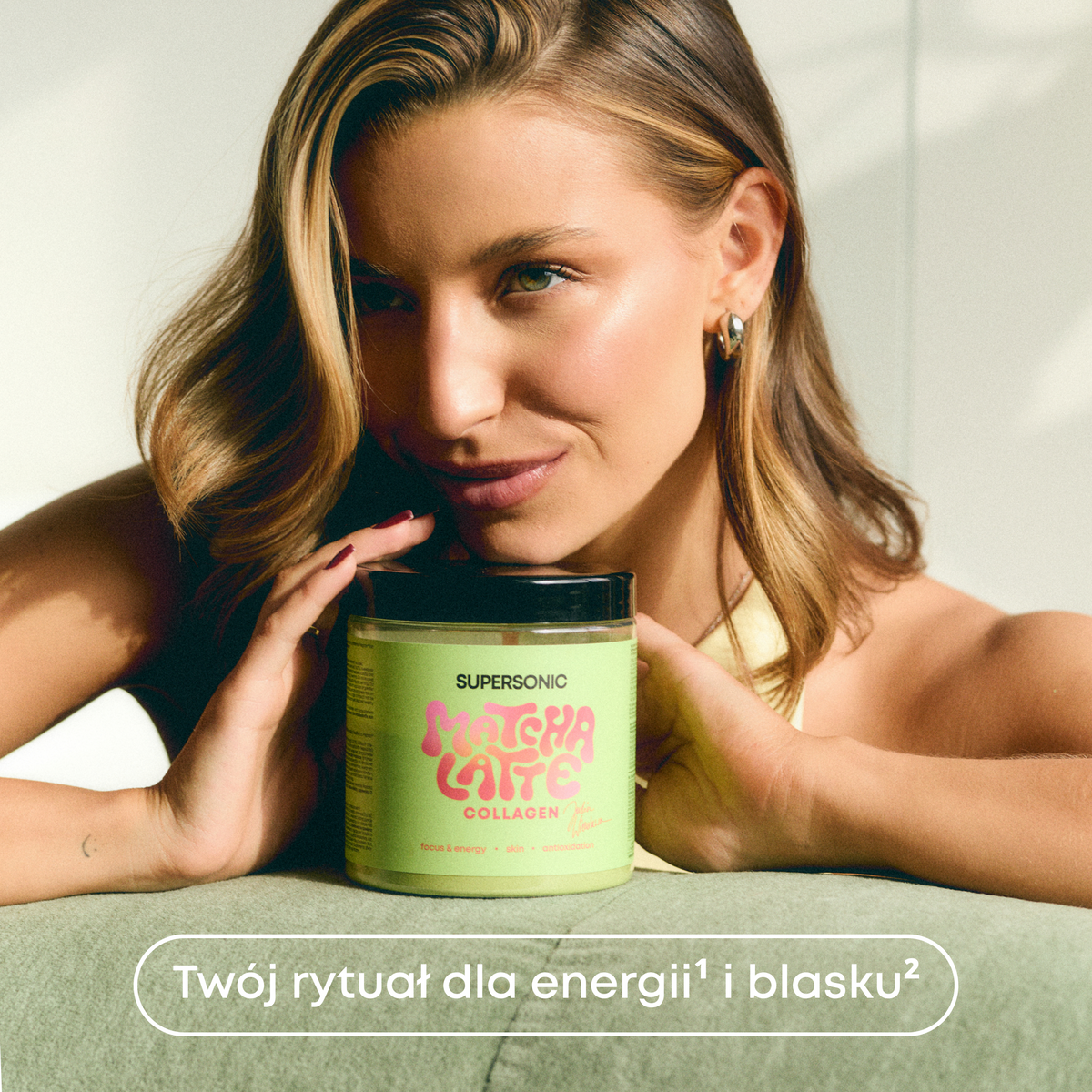
SUPERSONIC Beauty Collagen Drink contains three complementary forms of fish collagen in one serving: Peptan®, Verisol® i Liposovit®, a total of 5000 mg of collagen. Peptan® provides high-quality collagen peptides, Verisol® supports areas related to skin, elasticity and wrinkles, and Liposovit® uses liposomal technology developed for bioavailability. They complement the formula hyaluronic acid, vitamin C from wild rose, VinOmerix®, i.e. grape seed extract rich in polyphenols, biotin and probiotic LactoSpore®. This is a set designed with mechanisms in mind that become particularly important after menopause: lower collagen synthesis, greater susceptibility to oxidative stress, the need to moisturize the skin and support the absorption of ingredients. And does the collagen you use now contain anything more than just protein?
When to start collagen supplementation during menopause?
The sooner the better, but not because it is "too late". Research shows that collagen supplementation is effective even in women over 60, and the reconstruction of connective tissue is possible at any age. The point is that prevention is easier than reconstruction. Perimenopause, i.e. the period of several years before the last menstrual period, is the moment when estrogen begins to fluctuate and decrease. Then the loss of collagen already begins. Women who start supplementation during this period can slow down the process before losses become significant. Women who start after menopause also have something to benefit from. A study by Proksch and colleagues showed improvement in skin hydration, elasticity and density after 8 weeks of collagen peptide supplementation in middle-aged women.
Will collagen replace hormone replacement therapy?
No, and this should not be suggested. HRT works at the hormonal level and addresses the causes of collagen loss, not just its effects. Collagen is a complementary supplement that provides a substrate and signal for the reconstruction of connective tissue. Both strategies can be used simultaneously. The decision about HRT rests with the doctor and the patient.
FAQ
How much collagen do I lose after menopause?
Research indicates a loss of approximately 30% of skin collagen content during the first 5 years after menopause, and then approximately 2% annually for the following decades. This is the highest rate of collagen loss in a woman's entire life.
What collagen is best for menopause?
The most studied is fish collagen hydrolyzate in the form of bioactive peptides, especially Verisol® (skin, elasticity) and Peptan® (broad effect). What is important is a dose of at least 2.5–5 g per day and the presence of vitamin C as a synthesis cofactor. Formulas with hyaluronic acid, polyphenols and probiotics have additional value in the context of menopause.
Does collagen help with joint pain during menopause?
Yes. The loss of estrogen accelerates the degradation of collagen-rich articular cartilage. Supplementation with collagen hydrolyzate may support the reconstruction of cartilage and alleviate joint problems. Clark and Zdzieblik's research showed an improvement in joint comfort after collagen supplementation in active women over 45 years of age.
Can collagen help with osteoporosis after menopause?
Collagen constitutes approximately 30% of bone mass as an organic matrix. Research suggests that collagen peptides may support osteoblast activity and bone density. However, it does not replace osteoporosis medications or vitamin D and calcium, which are the basis for the prevention of this disease after menopause.
When to see the effects of collagen supplementation during menopause?
The first effects in terms of skin hydration and elasticity are visible after 4-8 weeks of regular supplementation. Effects in joints and bones take longer, usually 3-6 months. Regularity is important: collagen has a cumulative effect, and breaks in supplementation slow down the effects.
Can HRT and collagen be used together?
Yes. These are complementary strategies: HRT addresses the cause (estrogen deficiency), collagen provides a substrate for the reconstruction of connective tissue. There are no known interactions between collagen and hormone replacement therapy. The decision to use HRT requires consultation with a gynecologist.
Sources
Brincat MP, Hormone replacement therapy and the skin, Maturitas, 2000. pubmed.ncbi.nlm.nih.gov/10924836/
Proksch E, Segger D, Degwert J et al., Oral Supplementation of Specific Collagen Peptides Has Beneficial Effects on Human Skin Physiology: A Double-Blind, Placebo-Controlled Study, Skin Pharmacology and Physiology, 2014. pubmed.ncbi.nlm.nih.gov/23949208
Proksch E, Schunck M, Zague V et al., Oral intake of specific bioactive collagen peptide reduces skin wrinkles and increases dermal matrix synthesis, Skin Pharmacology and Physiology, 2014. pubmed.ncbi.nlm.nih.gov/24401291
Clark KL, Sebastianelli W, Flechsenhar KR et al., 24-Week study on the use of collagen hydrolysate as a dietary supplement in athletes with activity-related joint pain, Current Medical Research and Opinion, 2008. pubmed.ncbi.nlm.nih.gov/18416885
Castelo-Branco C, Duran M, González-Merlo J, Skin collagen changes related to age and hormone replacement therapy, Maturitas, 1992. pubmed.ncbi.nlm.nih.gov/1345134/

Looking for a nutritious and filling meal?
Discover Supersonic Smart Meal! A nutritious meal you can prepare in seconds!


