

For many people, morning coffee is a ritual that there is no point in disturbing. So it's natural to ask whether you can just pour collagen into it and be done with it. The answer is neither a simple yes nor a simple no. It depends on several things: the temperature of the coffee, the form of collagen, the composition of the supplement and what you expect from supplementation. Below we break it down step by step.
Does high temperature in coffee destroy collagen?
This is the first question that most people ask. Coffee is usually 85-95°C and intuitively one can assume that such a high temperature denatures the protein. In the case of native collagen, i.e. the one that builds skin or joints, this would make sense. But collagen supplements are hydrolyzed collagen, i.e. a protein that has already been pre-degraded into short peptides. These peptides are much more thermostable than the full-length protein. Research on collagen peptides shows that they retain their structure and biological activity at temperatures typical for cooking and brewing beverages. In other words: pouring hydrolyzed collagen into hot coffee does not destroy it in a way that would render it ineffective. You can do it without any worries.
Does caffeine affect collagen?
This is a more complex question. There are studies that show that caffeine in high concentrations can inhibit the activity of fibroblasts, i.e. cells that produce collagen. This sounds disturbing, but there are some important caveats. First, research means laboratory conditions on cells, not in a living organism. Secondly, the concentrations of caffeine used in such studies are often much higher than those that actually reach the tissues after drinking coffee. Third, there are no solid clinical studies that confirm that moderate coffee consumption (1-2 cups per day) translates into measurable inhibition of collagen synthesis in healthy people. With reasonable coffee consumption, there is no reason to fear its negative impact on collagen. The problem could arise with very high, chronic caffeine consumption, but this is a completely different scale than the morning cup.
What about vitamin C in a supplement?
This brings up one real point to consider. Vitamin C is essential for collagen synthesis and many collagen supplements contain it. However, vitamin C is sensitive to high temperatures, especially above 70°C, and may partially degrade when added to a hot drink. How much of it is actually lost depends on the coffee temperature and exposure time. If you pour the supplement into very hot coffee and drink it immediately, the loss is minimal. If you leave the drink for several minutes, the degradation may be more noticeable. The solution is simple: wait until the coffee cools down a bit (to approx. 60-65°C), or make sure to get vitamin C from other sources during the day if you mix collagen with hot coffee.
Is collagen and coffee absorbed the same way?
The absorption of collagen depends primarily on the form of the peptide, the condition of the intestines and what you eat during the day. Adding it to coffee does not significantly disturb this process. Studies by Iwai and colleagues have shown that collagen peptides do indeed enter the bloodstream after ingestion as di- and tripeptide fragments, confirming that absorption occurs regardless of the medium in which the collagen is ingested. However, it is worth knowing that collagen taken on an empty stomach or between meals may be absorbed more effectively than that taken with a large breakfast. If coffee is your only morning ritual, collagen with coffee is a good time. If coffee is accompanied by a large meal, the effectiveness may be slightly lower, although this is not a reason to give up supplementation.


What's the best way to combine collagen with coffee?
Some practical tips if you want to combine coffee with collagen in your daily routine:
- Wait until the coffee cools down to approximately 60-65°C before adding collagen, especially if the supplement contains vitamin C.
- Use hydrolyzed collagen powder. Tablets and capsules are not suitable for mixing with coffee, and collagen in a measuring cup or sachets will dissolve best in it.
- Mix thoroughly. Some collagen peptides may clump, especially in colder coffee. Mixing for several seconds is enough.
- Do not add collagen to ice coffee without first dissolving it. Cold water makes it difficult to dissolve peptides. First dissolve it in a small amount of warm water, then pour it into cold coffee.
- Check the taste in advance. Some collagens have a distinct fishy flavor, which may be noticeable when combined with coffee. Good quality collagen in a neutral or fruity flavor will go better with coffee.
Matcha with collagen as a better alternative?
If you want energy and care from the inside in one drink, matcha with collagen may be a good alternative to morning coffee. It's not just about changing the taste, but about a different way of working. Matcha stimulates more gently, easily fits into the morning ritual and allows you to combine your daily dose of energy with regular collagen supplementation. This is important because when it comes to collagen, what counts is regularity, not just one-time use from time to time. Matcha contains caffeine, but it comes with it naturally L-theanine. It is an amino acid that influences the nature of arousal - more stable, calmer and less violent than after classic coffee. Thanks to this, matcha can be useful for people who want to stay focused, but do not like a sudden peak of energy and a subsequent decline. Combined with collagen, it creates a drink that responds to two needs at the same time: concentration and skin care from the inside.
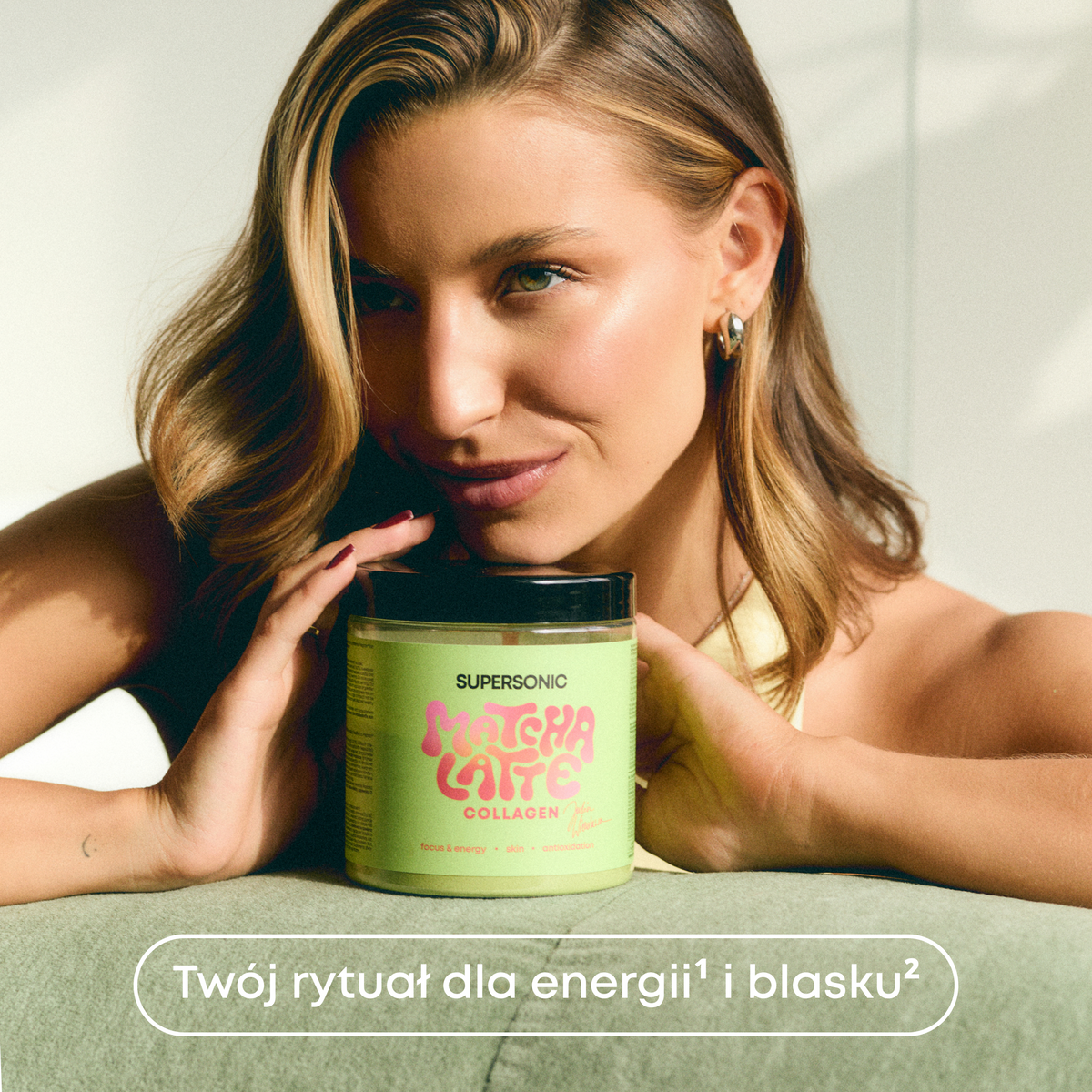
The method of preparation is also important. Matcha is usually prepared at a temperature of around 70-80°C, which is lower than classic coffee poured with boiling water. This is important if you want to combine collagen with a warm drink without unnecessarily treating the ingredients with very high temperatures. Instead of adding collagen to a random drink, you can choose a formula that was originally designed as a morning beauty drink. SUPERSONIC Matcha Latte Collagen is a ready-made formula combining Japanese BIO matcha with the JAS certificate and clinically tested collagen Peptan® per serving 2500 mg and coconut milk. Peptan® provides high-quality collagen peptides, and matcha supports daily energy and focus. Thanks to this, you do not have to prepare a stimulating drink separately and remember about collagen separately. Just about 30 seconds and one serving in the morning is enough to combine collagen, taste and energy in one dish. This form facilitates regularity, which is what is most important when supplementing with collagen. This is a solution for people who want to take care of their skin, but at the same time need a drink that suits their intense morning, work and everyday rhythm.
So is it worth combining coffee with collagen?
Drinking coffee with collagen is possible and does not destroy collagen in a way that would render it ineffective. Hydrolyzed collagen peptides are thermostable and absorbed regardless of the carrier. The only real caveat is the vitamin C contained in some supplements, which may partially degrade in a very hot drink. Just wait until the coffee cools down a bit. However, if you're looking for a more convenient formula that combines collagen with natural stimulation without the need for mixing, matcha with collagen is a solution worth considering.
FAQ
Can you pour collagen powder directly into coffee?
Yes, hydrolyzed collagen powder can be added to coffee. It is worth waiting for the drink to cool slightly if the supplement contains vitamin C, which is sensitive to high temperature.
Does caffeine destroy collagen?
With moderate coffee consumption (1-2 cups a day), there is no reason to fear the negative effect of caffeine on collagen. Studies suggesting the inhibition of fibroblasts by caffeine mainly concern high concentrations in laboratory conditions, incomparable to real consumption.
How many degrees should the coffee cool before adding the collagen?
Optimally up to approx. 60–65°C. At this temperature, collagen still dissolves well and the risk of vitamin C degradation is minimal.
Does collagen in coffee taste like fish?
Depends on the quality of collagen. Cheap hydrolysates may have a fishy aftertaste, which is unpleasant when combined with coffee. High-quality collagens are neutral or have a delicate fruity aroma that goes well with coffee.
What time is it best to drink collagen with coffee?
In the morning, preferably on an empty stomach or with a light breakfast. Collagen taken on an empty stomach may be absorbed more efficiently because it does not compete with other proteins for transport receptors in the intestines.
Does matcha with collagen work the same as coffee with collagen?
In terms of collagen, yes, because the active ingredient is the same. The difference lies in the source of the stimulation. Matcha provides caffeine along with L-theanine, which gives you calmer energy without the typical peaks and valleys of coffee. The brewing temperature of matcha (70–80°C) is also safer for the vitamin C in the supplement.
Sources
Iwai K, Hasegawa T, Taguchi Y et al., Identification of Food-Derived Collagen Peptides in Human Blood after Oral Ingestion of Gelatin Hydrolysates, Journal of Agricultural and Food Chemistry, 2005. pubmed.ncbi.nlm.nih.gov/16076145/
Shaw G, Lee-Barthel A, Ross ML et al., Vitamin C–enriched gelatin supplementation before intermittent activity augments collagen synthesis, The American Journal of Clinical Nutrition, 2017. pubmed.ncbi.nlm.nih.gov/27852613
Proksch E, Segger D, Degwert J et al., Oral Supplementation of Specific Collagen Peptides Has Beneficial Effects on Human Skin Physiology: A Double-Blind, Placebo-Controlled Study, Skin Pharmacology and Physiology, 2014. pubmed.ncbi.nlm.nih.gov/23949208
Pullar JM, Carr AC, Vissers MCM, The Roles of Vitamin C in Skin Health, Nutrients, 2017. pubmed.ncbi.nlm.nih.gov/28805671

Looking for a nutritious and filling meal?
Discover Supersonic Smart Meal! A nutritious meal you can prepare in seconds!


