

You choose a protein supplement without artificial sweeteners by checking three things on the label: the list of sweeteners, the protein source and the "contains sweetener" declaration. The biggest catch lies in sweeteners considered natural, which in large doses still cause flatulence or osmotic diarrhea, even though they have nothing to do with aspartame or sucralose.
- The answer to the question of how to choose a protein supplement without artificial sweeteners begins with reading the label, not with the slogan on the front of the packaging.
- Erythritol has a glycemic index of 0 and almost zero calories, but doses above 40-50 g a day may cause flatulence.
- Stevia has been approved in the European Union as a food additive since 2011.
- EU food law requires the words "contains a sweetener" on the packaging when a product contains a sweetener.
- It is worth comparing the composition in person on several products, e.g. on the label of SUPERSONIC WHEY 360 Grass Fed.
Why it matters
Artificial sweeteners have been blacklisted by many consumers after a series of media reports, but not all allegations are supported by regulatory data. The World Health Organization recommends limiting free sugars to less than 10% of daily energy, and it is this recommendation from 2026 that is driving the demand for protein supplements without added sugar and without artificial sweeteners.
The problem is that manufacturers replace one sweetener with another, and the label still requires careful reading. Before you reach for the first shaker with powder, check the composition of a specific product, for example SUPERSONIC WHEY 360 Grass Fed, or SUPERSONIC Protein Shake and compare them with other items on the market instead of believing the "natural" claim on the front of the package.
How to choose a protein supplement without artificial sweeteners – checklist
Comparing the most commonly used sweeteners helps you recognize what is actually in the powder.
| Sweetener | Type | Calories | Glycemic index | Legal status in the EU |
|---|---|---|---|---|
| Stevia | Natural | 0 kcal | 0 | Admitted since 2011 |
| Erythritol | Natural (polyol) | approx. 0.2 kcal/g | 0 | Approved as a food ingredient |
| Xylitol | Natural (polyol) | approx. 2.4 kcal/g | 7-13 | Approved, toxic to dogs |
| Aspartame | Artificial | 0 kcal | 0 | ADI 40 mg/kg body weight/day (EFSA 2013) |
| Sucralose | Artificial | 0 kcal | 0 | ADI 15 mg/kg body weight/day |
| Acesulfame K | Artificial | 0 kcal | 0 | ADI 9 mg/kg body weight/day |
A simple rule follows from this table: if you see E951 (aspartame), E955 (sucralose) or E950 (acesulfame K) on the label, you are dealing with a synthetic sweetener, regardless of how "healthy" the packaging looks.
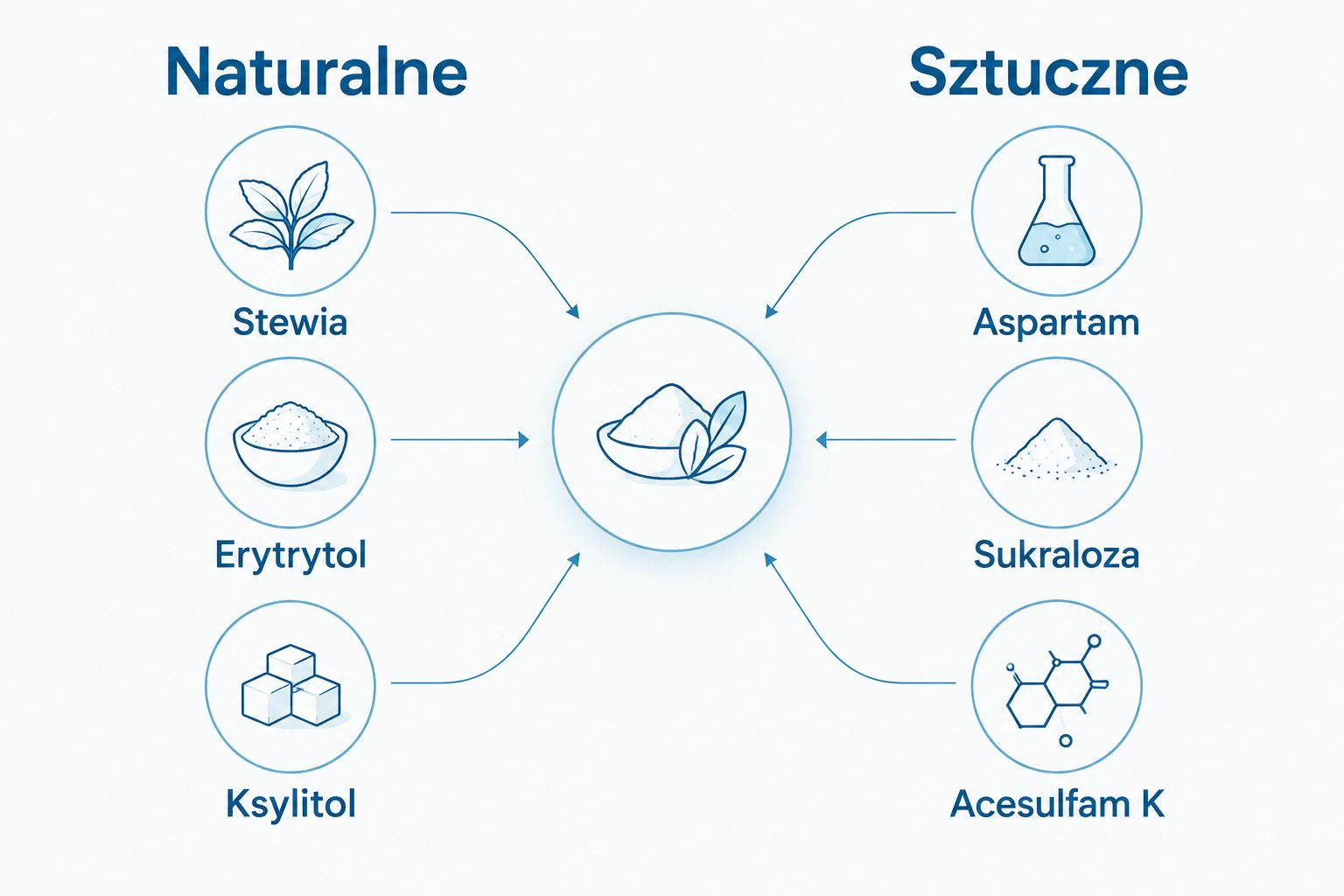
Erythritol: glycemic index 0 and almost zero calories
Erythritol does not raise blood sugar levels because the body absorbs it only to a small extent and excretes it mainly through the kidneys. At doses exceeding 40-50 g per day, some people experience flatulence or osmotic diarrhea - this is the only real disadvantage of this sweetener in 2026.
Stevia: approved in the EU since 2011
Stevia was added to the EU list of food additives in 2011 and since then it has been one of the most frequently chosen sugar substitutes in protein supplements. Its disadvantage is a characteristic, slightly licorice-like aftertaste in high concentrations, which producers mask with the addition of erythritol.
Aspartame and sucralose: ADI 40 mg/kg and 15 mg/kg body weight
The European Food Safety Authority (EFSA) conducted a full re-evaluation of aspartame in 2013 and confirmed an acceptable daily intake (ADI) of 40 mg per kilogram of body weight. Sucralose has the lower ADI - 15 mg/kg - and acesulfame K has the lowest ADI of the three, 9 mg/kg. These values do not change from year to year, but they do not change the fact that these are synthetic compounds, not fermented or extracted from the plant.
Why do the compositions of protein supplements differ?
- Raw material cost – stevia and erythritol are more expensive to purchase than aspartame, which affects the shelf price.
- Masking the aftertaste – natural sweeteners have a cooling-sweet note, which is more difficult to balance than synthetic ones.
- Target group – "clean label" products versus a budget offer addressed to a mass audience.
- Labeling requirements – EU food law imposes specific provisions for both types of sweeteners.
- Taste stability during storage – some sweetener combinations lose their intensity after a few months.
- Growing demand in Poland – more and more buyers are looking for nutritional supplements without added sugar and artificial sweeteners, which is changing the priorities of recipes for 2026.
It is also worth checking how to choose a protein supplement for your training purpose, because the sweetener composition is only one of several parameters that determine the choice - details are described in the guide. how to choose protein supplement for training purposes.
Is stevia better than sucralose?
Stevia is a plant extract approved in the EU since 2011, and sucralose is a synthetic compound with an ADI set at 15 mg/kg body weight. For people who want to avoid artificial sweeteners, stevia is the only option of the two that meets this criterion - taste-wise, both have a distinctive aftertaste in high concentrations.
Does erythritol cause flatulence?
Erythritol causes flatulence mainly after exceeding 40-50 g per day, because the body does not absorb the entire dose and the rest goes to the small intestine. With a typical portion of protein supplement, which usually contains several grams of erythritol, this effect practically does not occur.
How to check the composition of a protein supplement on the label?
The label must include the words "contains a sweetener" right after the product name if the recipe contains any sweetener - this is a requirement of EU food law, not the manufacturer's good will. You'll find the sweetener itself in the ingredients list, ranked from largest to smallest amount, so its position on the list also says something about the dosage.
Compare the composition of SUPERSONIC supplements
Check the full ingredient list before purchasing.
FAQ
Does protein supplement without artificial sweeteners exist?
Yes, there are supplements on the market sweetened only with stevia or erythritol, without aspartame, sucralose or acesulfame K. The key is to check the list of ingredients, not the slogan on the packaging.
How many calories does erythritol have?
Erythritol has about 0.2 kcal per gram, which is practically zero in a serving of protein powder. This is one of the reasons why it is entering the recipes of low-calorie products in 2026.
Is xylitol safe for dogs?
No, xylitol is highly toxic to dogs even in small doses and can cause life-threatening hypoglycemia. For humans, it is a safe sweetener approved in the EU, but keep xylitol supplements out of the reach of animals.
What is the difference between stevia and erythritol?
Stevia is a plant extract with intense sweetness, so it is used in small quantities, and erythritol is a polyol with a sweetness closer to sugar, added in larger volumes. In practice, manufacturers combine both substances to eliminate the aftertaste of each.
Is sucralose harmful?
Sucralose has an acceptable daily intake set at 15 mg/kg body weight by EFSA and is considered safe within these limits. For people looking for a protein supplement without artificial sweeteners, this is a compound that should be excluded regardless of its safety profile.
How to recognize artificial sweetener on the label?
Artificial sweeteners have the numbers E951 (aspartame), E955 (sucralose) and E950 (acesulfame K) in the ingredient list. Natural alternatives are marked as erythritol or xylitol.
Does conditioner without sweetener taste worse?
The supplement without any sweetener tastes significantly less intense, because the isolated protein itself has a neutral or slightly bitter aftertaste. A conditioner without artificial sweeteners, but with a natural alternative such as stevia or erythritol, maintains sweetness without this compromise.
One last thing
Hardly anyone reads Regulation (EU) No. 1169/2011 in their free time, and it is this document that requires manufacturers to place the phrase "contains a sweetener" directly next to the product name, not in small print at the end of the label. If you don't see this provision on the front of the packaging, check the list of ingredients again - in 2026, this requirement still applies to every manufacturer of protein supplements sold in the European Union, without exceptions.
Related guides


