

After discontinuing creatine, its direct training support gradually fades away, but the developed muscles do not disappear with the last portion. Water-related weight loss does not automatically mean loss of muscle tissue. In the guide for 2026, we separate changes in creatine reserves from changes in strength, body appearance and the effects of regular training.
- How long do the effects of creatine last after stopping? Increased muscle stores usually return to baseline levels in 4-6 weeks.
- Lower body weight after stopping creatine is not in itself evidence of muscle loss.
- Maintaining your training results depends on continued exercise, eating and recovery, not just supplementation.
- Supersonicfood offers creatine to active people; the supplement does not replace training or proper nutrition.
How long do the effects of creatine last after stopping?
Elevated muscle creatine stores usually return to baseline levels within 4–6 weeks of cessation of supplementation. This is an approximate time for changing muscle reserves, not a date for loss of strength or muscle mass. It does not set a day when everyone will notice the change in their figure.
This range describes the position of the International Society of Sports Nutrition regarding the effectiveness and safety of creatine supplementation. It concerns the return of increased muscle resources to baseline values after discontinuation, not the durability of all training results. In the practical interpretation for 2026, this distinction is the most important.
| What do you rate? | What does stopping creatine mean? | What should you not assume? |
|---|---|---|
| Creatine reserves in muscles | They gradually return to baseline levels, usually within 4-6 weeks | That the body is completely deprived of creatine |
| Body weight | Changing the amount of water in your muscles can lower your score on the scale | That all the decline is due to muscle loss |
| Repeated intense efforts | The additional support from supplementation gradually wears off | That every workout will immediately be worse |
| Developed muscle tissue | Its maintenance depends primarily on training and nutrition | That muscles disappear along with increased creatine reserves |
If you are just learning about supplementation, start with the guide creatine for beginners in the gym. It will be easier to evaluate the break when you distinguish the effect of the supplement from the effects of the entire training plan.
Why does this matter?
Weight, muscle appearance and training result describe different things. You can see a lower body weight without losing the muscle tissue you have gained. You may also perform a weaker workout due to lack of sleep, even though your creatine stores are still elevated.
Don't treat every weight loss as a reversal of progress. This interpretation leads to unnecessary increases in eating, chaotic changes in exercise, or returning to the supplement without checking the cause. First, determine which effect actually changed.
Creatine primarily supports the ability to perform short, intense efforts, especially repeated ones. Larger creatine reserves help to quickly recreate ATP, a direct source of energy for working muscles. It is a support for exercise, not an independent body building mechanism.
Creatine stores: typically 4-6 weeks to baseline
After supplementation, the body does not remove all the creatine at once. It still produces it on its own, and the diet can provide it from animal products. Stopping means ending the additional supply, not turning off the natural creatine metabolism.
Compartment 4–6 weeks is the reference point for increased muscle reserves. It does not mean that the support is identical all this time and then suddenly disappears. Change happens gradually.
The starting point is also important. If supplementation has not led to a marked increase in stores, discontinuation may not make a noticeable difference. The mere fact of taking creatine does not indicate how much change has occurred in the muscles.
In 2026, it is still wiser to evaluate the course of the interruption rather than looking for a single end date. Recording the last portion helps organize your observations. However, it does not replace comparison of training and the conditions in which you perform it.
Body weight: less water does not mean less muscle
Creatine supplementation can increase the amount of water inside muscle cells. Once completed, some of this change may be reversed. Muscles may appear less full and body weight may decrease.
Muscle water and muscle tissue are not the same thing. A home scale shows your total body weight, not the reason for your weight change. Even bioimpedance body composition measurement depends on hydration, so a single reading doesn't determine whether you've lost muscle.
The result is also influenced by the amount of carbohydrates in the diet, the content of the digestive tract and the measurement conditions. If you're cutting out creatine, cutting back on your food, and increasing your activity at the same time, don't attribute the entire change to the supplement. You change several factors at once.
It is most useful to compare measurements taken under similar conditions. Weigh yourself at a similar time and do not compare the measurement after a large dinner with the measurement after training. Also compare the silhouette photos in similar light and without differences resulting from the training pump.
Strength and performance: there is no common term for everyone
Returning creatine stores to baseline does not result in an identical decline in strength for every person. The result also depends on technique, adaptation to training, rest and available energy. The ability to perform the exercise does not disappear after discontinuing the supplement.
The change may be more noticeable during repeated intense exercise than during leisurely activity. Examples include successive demanding sets or repeated sprints. However, this does not mean that you can predict in advance how many reps you will lose.
Compare similar tasks, not random workouts. The same weight, similar rest periods and the same order of exercises allow you to better assess the difference. The result from the beginning of training is not equivalent to the result after several hard exercises.
If only the subjective feeling of muscle fullness decreases, but the loads and number of repetitions remain stable, you have no grounds to conclude that you have lost strength. Separate appearance from function. It's easier than trying to explain everything with one scale reading.
Muscles: Maintenance depends on what you do next
Muscle tissue built during supplementation is not a temporary store of creatine. It is created thanks to adaptation to training with appropriate nutrition. Creatine can support training work, but it does not replace the stimulus that causes this adaptation.
After stopping, you still need regular resistance training, adequate energy and protein intake, and recovery. If these elements remain stable, simply stopping supplementation is not a reason to expect sudden muscle loss. The situation is different when you stop exercising and severely limit your eating at the same time.
Don't try to compensate for the break with more sets at any cost. Excessive fatigue makes it difficult to evaluate results and regenerate. Maintain a plan that you can perform regularly and adjust the loads to your current fitness level.
Why are the effects after discontinuing creatine different?
There is no single scale of change appropriate for all people. The same completion of supplementation takes place with different levels of muscle reserves, different diets and different training conditions. Therefore, it is worth basing the observation on several factors:
- Previous creatine stores. Short or irregular supplementation does not provide the same starting point as maintaining elevated resources.
- Type of activity. Repeated intense exercise benefits from the effects of creatine differently than a leisurely walk.
- Continuity of training. Stopping the supplement and stopping training are two separate changes.
- Diet and energy balance. Insufficient nutrition makes it difficult to maintain fitness and muscle mass regardless of supplementation.
- Hydration and measurement conditions. They influence weight, body shape and the interpretation of body composition measurements.
- Sleep and regeneration. Fatigue may reduce training results without any connection with the moment of discontinuation of creatine.
It's not about controlling every variable perfectly. The idea is not to change everything at once. Then you will more easily recognize whether you are observing a change related to supplementation, diet or a break in training.
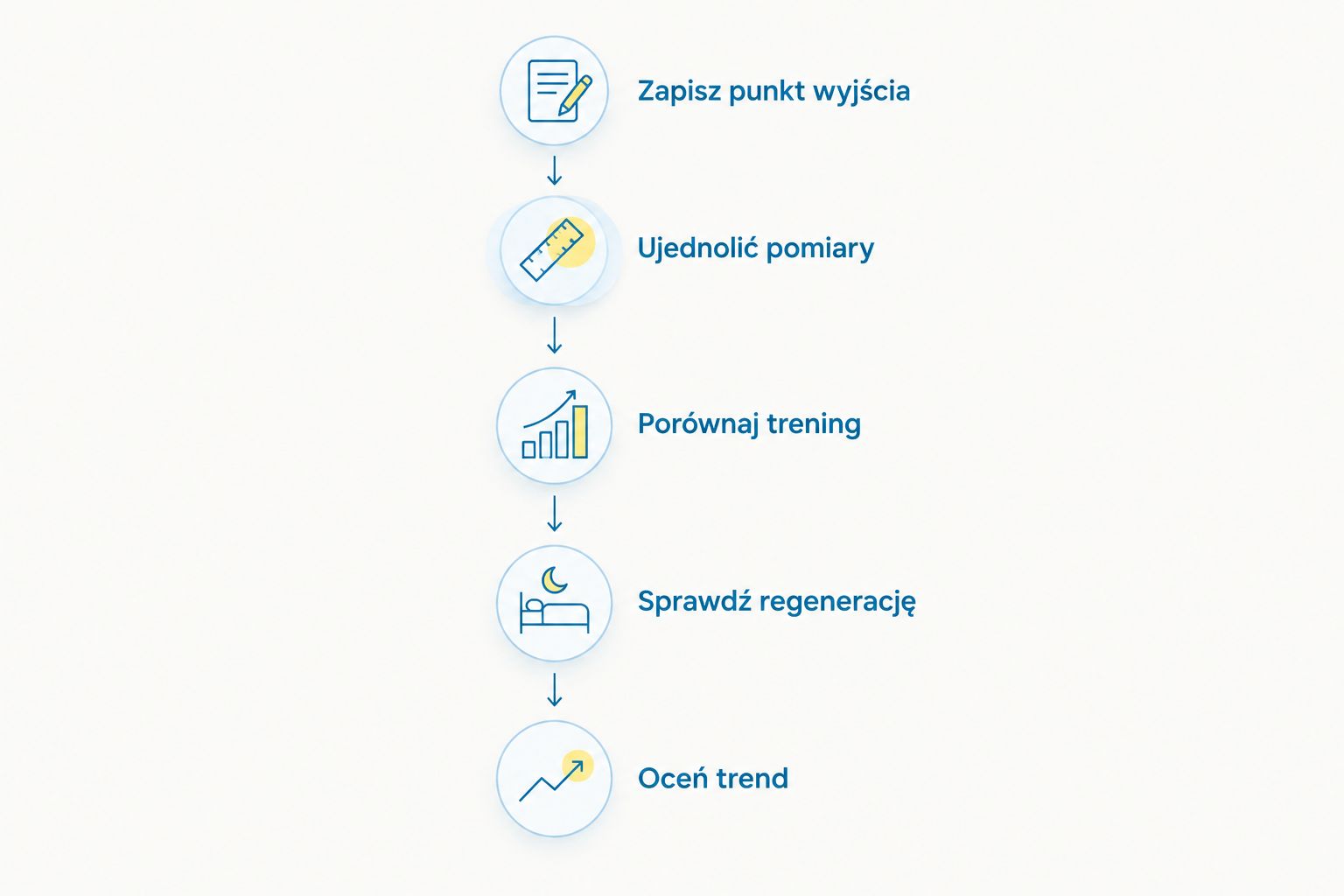
How to check what has changed after stopping?
In your observation plan for 2026, choose a few simple measurements instead of assessing your figure in the mirror every day. Write down the facts. “Less muscle fullness” and “fewer reps with the same weight” are different things.
- Record your starting point. Record your discontinuation date, body weight, and performance on selected exercises. Add information about changing your diet or training.
- Standardize measurements. Weigh yourself under similar conditions. As a practical way to observe, compare your average weight over a 7-day period rather than reacting to a single reading.
- Compare training. Record your load, reps and rest periods. Do not compare a set performed after rest with a set performed while very tired.
- Check recovery. Include whether you slept less, trained harder or ate less. This information helps explain the worse outcome.
- Assess the trend. Schedule a review of your notes after 2 weeks and then after an indicative 4-6 weeks. These are observation dates, not a guarantee of changes.
Such recording does not require specialized equipment. All you need is a scale and a notebook. The most important thing is repeatability, because even an accurate measurement made in different conditions may lead to an incorrect conclusion.
Is it necessary to gradually reduce the dose of creatine?
There is no need to gradually reduce the dose of creatine before completing standard supplementation. Muscle reserves also decrease gradually after complete cessation of use. Stopping supplementation does not cause a typical withdrawal syndrome.
This is not a recommendation to self-administer supplementation for illness. If the reason for the break is ailments, abnormal test results or a doctor's recommendation, follow individual instructions. Do not try to solve a health problem by changing your dosage regimen.
Do you need to eat more protein after stopping creatine?
Stopping creatine does not in itself increase protein requirements. Creatine and protein have different functions. A larger portion of protein will not replace increased creatine stores in the muscles.
Rather, check whether the current way of eating corresponds to your activity and goal. If you're restricting energy or skipping meals, simply adding a protein supplement won't solve the whole problem. The basis remains regular nutrition adapted to training.
Is it worth returning to creatine after a break?
Returning makes sense when supplementation meets your training goal and there are no health contraindications. Don't make this decision just because the scale shows less. First check whether the efficiency has changed, not just the amount of water.
Supersonicfood is a brand of functional food and supplements for people looking for convenient support for everyday nutrition. If you are considering supplementing again, you can check out the website Creatine Monohydrate. Before choosing, read the current label, composition and method of use.
The advantage of creatine is its documented use during repeated intense exercise. The restriction remains simple: it is not a replacement for training, eating or sleep. Creatine from Supersonicfood is subject to the same restriction; the brand does not change the physiology of the supplement's action.


When should you consult your doctor for a break?
Kidney disease, abnormal test results or treatment requiring monitoring of kidney function are reasons for individual consultation. In this case, do not use the general guide as an instruction to start or resume supplementation. Tell your doctor what preparation you were taking and when you stopped taking it.
Information about creatine is also important when interpreting creatinine. Supplementation may affect its concentration, and creatinine is used to assess kidney function. The result itself needs to be assessed in the context of health, and not automatically attributed to the supplement.
Do not explain sudden weakness, swelling or a noticeable change in urination as the mere end of the effect of creatine. These are signals that require medical evaluation. The approximate recovery interval of muscle reserves is not intended to diagnose symptoms.
Frequently asked questions
How long do the effects of creatine last after stopping?
Elevated muscle creatine stores usually return to baseline levels in 4-6 weeks. This range does not determine the duration of maintaining the developed muscles or the individual strength result.
Will I lose all my muscle when I stop taking creatine?
No, stopping creatine does not automatically cause the loss of muscles. Their maintenance depends primarily on further training, proper nutrition and regeneration.
Why do I weigh less after stopping creatine?
Lower body weight may result from a reduction in the amount of water in the muscles. The result on the scale alone cannot distinguish a change in hydration from a change in muscle or fat tissue.
Does creatine stop working the day after you stop taking it?
No, creatine stores do not return to baseline levels immediately after the last serving. The change is gradual and its impact on training is not the same for everyone.
Do I need to gradually stop taking creatine?
There is no need to gradually reduce the dose before completing standard creatine supplementation. If the break is due to a health problem or a doctor's recommendation, follow individual recommendations.
Will protein replace creatine after a break?
No, protein does not replace creatine because it serves a different function in the body. An adequate supply of protein supports muscle maintenance, but does not reproduce the effects of increased creatine stores.
Can I stop taking creatine while cutting?
You can stop supplementing while cutting, but weight loss should not automatically be considered fat loss. Changing the amount of water makes it difficult to compare individual weight measurements.
Does creatine make the body addicted to the supplement?
Creatine does not cause typical addiction or withdrawal syndrome. After supplementation ends, the body continues to produce creatine, and the increased muscle reserves gradually return to the initial level.
Finally: write down the reason for the break
Before you stop taking the supplement, write down what you expect from the break. Do you want to check your weight, compare training results or follow your doctor's recommendation? Each of these goals requires a different way of assessment.
The best observation is one that answers a specific question. If you are checking the effect of creatine on training, do not change your entire plan and diet at the same time. When it comes to health, consultation takes precedence, not experimentation.
In 2026, the rule remains simple: Supersonicfood and other brands can provide a supplement, but daily work also determines maintaining the effects. Assess creatine stores, water and muscle separately. Only then does the result on the scale become important.
Related guides


