

About 30g of protein in one meal is a practical starting point for a healthy strength-training adult; the typical range given by ISSN is 20-40 g. This is not an absorption limit: adjust the portion primarily to your daily requirement, body weight and number of meals. This 2026 guide shows you how to count your portion without turning every dinner into a math problem.
- How much protein in one meal? For strength training, 20-40 g is a practical range, not an absorption limit.
- First determine your daily protein intake, then divide it between meals.
- A larger portion of protein is not automatically lost; absorption and muscle building are different processes.
- SUPERSONIC Food offers convenient high-protein nutrition options; Always check the protein serving size on the label.
Why does it matter? Just adding a shake doesn't tell you whether you're eating enough protein. The whole day counts, not just the post-workout meal. If you are looking for convenient solutions, also read the guide on ready high-protein meals for busy people.
How much protein should you eat in one meal?
For a healthy training person, 20-40 g of protein in a meal is a useful starting point. The position of the International Society of Sports Nutrition, or ISSN, also provides indicative information 0.25 g of high-quality protein per kilogram of body weight in a single serving. These are nutritional tips for active people, not a universal recipe for everyone.
The easiest way is to start with your daily goal. Then divide it by the number of meals in which you actually plan to eat protein. You don't have to get the same result for every breakfast, lunch and dinner.
The following comparison compares planning methods, not specific products. Each serves a different purpose.
| Planning method | For whom it is most useful | Benefit | Limitation |
|---|---|---|---|
| Indicative 20-40 g per meal | Healthy training people who want a simple starting point | Makes it easier to compose meals | Does not replace calculation of daily requirement |
| Daily goal divided by the number of meals | People with a set goal nutritional | Adjusts the portion to the whole day | Requires prior setting of the appropriate goal |
| Individual diet plan | People with diseases, special needs or medical recommendations | Takes into account the health condition | It cannot be replaced by a table with internet |
The basis of the sports scope is the ISSN position "Position Stand: protein and exercise", concerning healthy people exercising. In the 2026 guide, we use them as a guide to diet planning, not as proof that each person needs exactly the same portion.
First count the protein for the whole day
The portion on your plate is part of a larger plan. The European Food Safety Authority, or EFSA, sets the reference protein intake for healthy adults at 0.83 g per kilogram of body weight per day. This is a reference value for the general population, not an athletic muscle-building goal.
For most healthy exercisers, ISSN recommends 1.4-2.0 g of protein per kilogram of body weight per day. Don't automatically transfer this range to an inactive person, a child, or someone with kidney disease. First choose the recommendation appropriate to your situation.
Calculation example: a 70 kg person who adopts a sports goal of 1.6 g/kg per day receives 112 g of protein per day. When divided into 4 meals, it amounts to 28 g per meal. This is the result of a mathematical operation, not an individual nutritional diagnosis.
In turn, 70 kg multiplied by the reference 0.83 g/kg gives approximately 58 g per day. The difference shows why just asking about protein in one meal is not enough: first you need to know who the meal is for.
The source of the reference value is EFSA's "Dietary Reference Values for protein", covering the needs of a healthy population. Sports coverage comes from ISSN's position on exercisers; both values have a different scope of application.
Four meals: 28g of protein in example
If your set goal is 112g per day, splitting into 4 meals will give you 28g of protein each. This is a convenient arrangement for a person who eats breakfast, lunch, an additional meal and dinner. It does not require storing most of the protein in the evening.
Dividing into 4 meals works best when it fits into your day. Its advantage is that it is easy to spread the supply. The limitation is that you have to find room for an additional meal if you usually only eat breakfast, lunch and dinner.
You don't have to hit exactly 28g every time. A larger lunch and a smaller snack can still make for a sensible plan. Check the total rather than tweaking each meal to a perfect number.
Three meals: about 37g of protein in example
The same goal of 112g per day divided into 3 meals gives about 37g of protein per meal. This arrangement is practical if you prefer larger breakfasts, lunches and dinners instead of frequent snacks. You still need to count what actually ends up on your plate.
Dividing into 3 meals is good for people who prefer smaller, larger portions. The advantage is a simple schedule. The limitation is the larger amount of protein to include at each meal, especially when breakfast usually consists of only coffee and bread.
Don't add another meal just because another plan looks more sporty. Choose a layout that allows you to consistently meet your actual daily goal, rather than just looking good on the app.
Five meals: approximately 22g of protein in example
With a goal of 112g per day, splitting into 5 meals gives approximately 22g of protein per meal. This is a solution for people who prefer smaller portions or already have such an eating rhythm. It doesn't mean that everyone has to eat more often.
Splitting into 5 meals makes sense when smaller portions are more convenient for you. The benefit is that there is less protein to fit into a single meal. The limitation is more opportunities to prepare food and keep an eye on the stock.
All three examples are based on the same daily goal. They are not a ranking of effectiveness. In 2026, the most important practical question is still: which pattern can you maintain in a typical week?
Why does the amount of protein in a meal vary?
There is no one size fits all. The way protein is broken down is influenced by both the body's needs and the actual daily schedule. Check these factors before copying someone else's menu.
- Body weight. Recommendations expressed in g/kg lead to different daily amounts for people of different weight.
- Activity and training goal. The reference value for the general population is not the same as the range used in sports nutrition.
- Number of meals. The same daily goal requires a larger portion eaten less frequently.
- Protein source. Essential amino acid content and digestibility influence nutritional value proteins.
- Age. In older people, the muscle response to a protein meal is different; it is worth adapting the plan individually.
- Health condition. Kidney diseases and other clinical situations require recommendations tailored to the diagnosis.
The guide for 2026 applies primarily to healthy adults. If you have medical recommendations, they are more important than the examples presented here. Do not increase your protein supply contrary to the plan agreed with your doctor or dietitian.
How to check the protein in your meal?
Count protein in the portion you eat, not in the portion suggested by the product name. The large inscription on the packaging does not replace the nutritional table. This also applies to SUPERSONIC Food products.
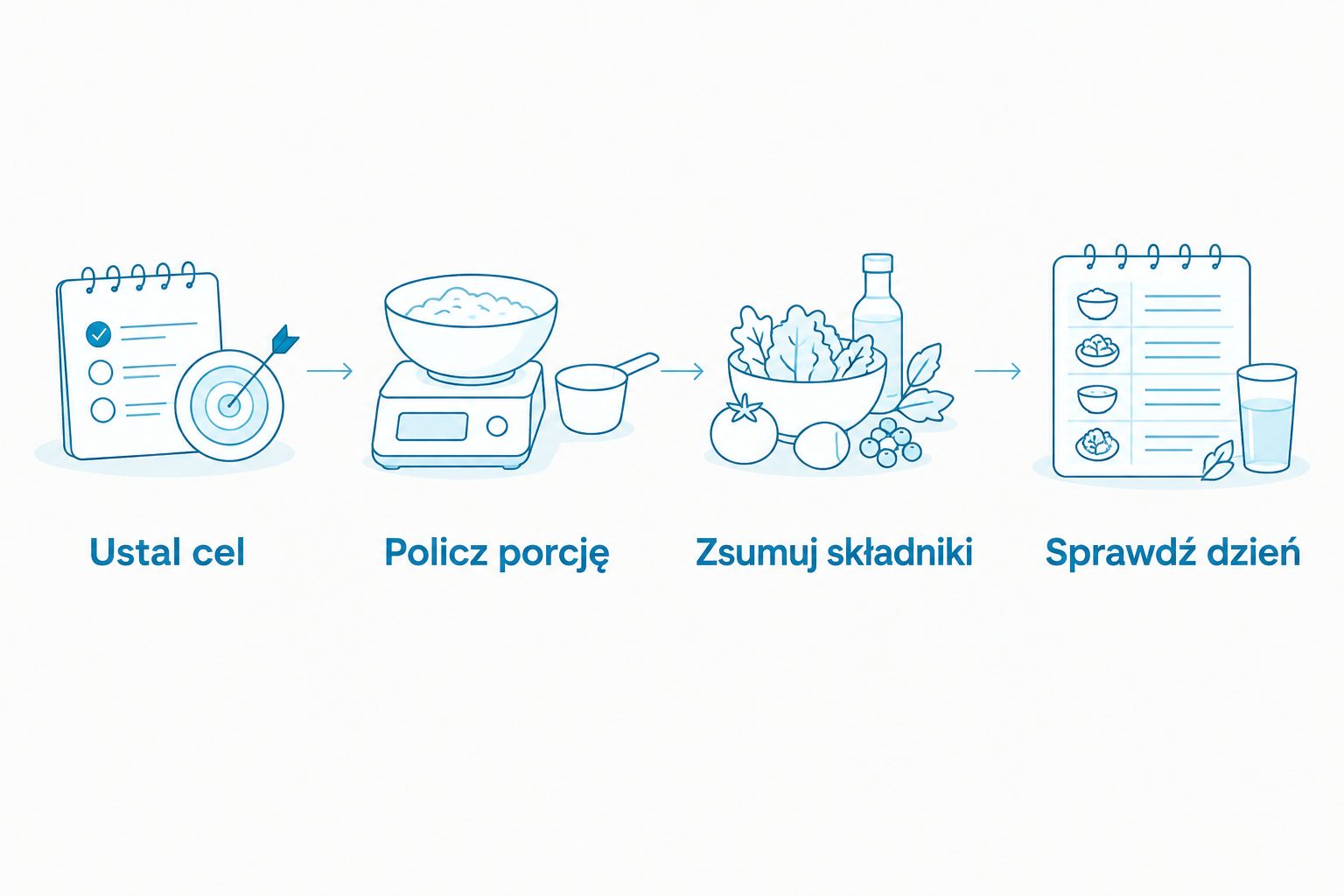
- Set a goal. Write down the daily amount of protein appropriate to your activity and health.
- Count the portion. If the label gives values per 100 g, convert them to the actual weight of the food.
- Sum up ingredients. Include all components of the meal, not just its main source of protein.
- Check the day. Add the results from the remaining meals before deciding on the next portion.
These steps protect against a common mistake: the weight of the powder or finished product is not the weight of the protein it contains. If you measure a product with a measuring cup, also check the portion weight declared by the manufacturer.
Keep measurement consistency when preparing food. Do not combine the weight of the dry product with the table for the cooked product. Cooking changes the amount of water, so the value per 100 g may look different even though the same ingredient is used.
Can the body absorb more than 30g of protein at a time?
30g of protein is not the limit of absorption. The body digests larger portions, and it also uses amino acids outside the muscles. The claim that anything above this amount is automatically wasted confuses digestion with the muscle response to a meal.
Muscle protein synthesis is just one of the processes in which the body uses amino acids. Proteins also participate in the construction of other tissues and the formation of enzymes and many other compounds. However, a larger portion does not mean proportionally greater muscle growth.
In practice, you do not have to skip dinner just because it contains more than 30 g. Check whether it fits your daily goal, whether it is well tolerated and whether it does not displace other elements of the diet. These are better criteria than the alleged limit.
Is 20 g of protein after training enough?
20 g of protein is within the ISSN range, but it is not a guarantee of the right portion for every person. Body weight, type of protein, training scope and daily intake all play a role. Don't treat the lower limit as a mandatory goal.
If you eat a normal meal after training with an adequate source of protein, a shake is not automatically necessary. The supplement is intended to supplement the diet, not to confirm that the training was performed correctly. First check the meal, then choose the addition.
Don't judge regeneration solely by the protein content in one drink. Energy from your diet, carbohydrates, sleep and the training plan itself also matter. Simply increasing protein portions does not solve all recovery problems.
Is 40g of protein at dinner too much?
40g of protein at dinner is not automatically too much for a healthy adult. This amount may fit into a larger daily goal or a plan with fewer meals. However, it is not mandatory just because dinner falls after training.
If you eat most of your protein in the evening, check your breakfast and lunch in advance. Spreading out your protein sources throughout the day makes it easier to follow your plan without a very large final portion. It's not about banning a larger dinner, but about convenient planning.
When does a convenient supplement make sense?
The supplement is useful when you don't achieve your goal with regular meals or you need an easy-to-prepare portion. An example of such a category is SUPERSONIC Whey 360 Grass Fed. Check the amount of protein in a specific portion on the current label.
SUPERSONIC Food is an option for people looking for a convenient high-protein diet. The benefit of the supplement is a simple addition to the menu. The limitation is that the supplement itself does not replace a varied meal, and the tolerance of ingredients and allergens must be checked individually.
In the guide for 2026, we do not assign a specific number of grams of protein to the product without a label. The same rule should guide your purchases: choose based on ingredients and portions, not just the word "protein."
FAQ
How much protein should I eat in one meal if I exercise?
20-40g of protein per meal is the practical range provided by ISSN for healthy exercisers. Adjust your serving size based on your body weight, daily goal and number of meals, rather than using this range as a hard limit.
Is protein above 30g in a meal wasted?
Protein above 30g in a meal is not automatically wasted. The body uses amino acids for more than just building muscle, and muscle response to a meal is not the same as absorption capacity.
How much protein per meal comes out to four meals a day?
With an example goal of 112g per day and 4 meals, that comes out to 28g of protein per meal. First, set your own daily goal; this result is an example of a calculation, not a recommendation for everyone.
Do I need to drink a shake after every workout?
You don't have to drink a shake after every workout if you get enough protein from your meals. The supplement is a tool to supplement the diet, not a mandatory element of training.
Does the weight of a portion of the supplement mean the amount of protein?
The weight of a portion of the supplement does not mean the amount of protein. Check the protein content in the nutritional table and convert it to the actual measured portion.
Will collagen replace regular sources of protein in your diet?
Collagen should not replace a variety of sources of protein in your diet. It does not provide a full set of essential amino acids, therefore it is not equivalent to full-value sources of protein.
Can I use sports protein if I have kidney disease?
If you have kidney disease, do not use sports protein without the recommendations of your doctor or dietitian. The appropriate supply depends on the diagnosis, stage of the disease and treatment.
One more thing
Before you increase the largest meal, check the one in which there is almost no protein. It is often a more practical change to add a source of protein to breakfast rather than adding another portion to an already large dinner. Start with your own menu, not by purchasing a supplement.
For another regular day, write down your meals and count the actual portions. Then evaluate the sum and distribution. This simple overview will show you where you need to change, without creating an artificial limit for each plate.
Related guides


