

Yes, matcha with collagen contains caffeine from matcha; collagen itself is not its source or neutralizes it. The amount of caffeine depends on the recipe and portion size, so in 2026, choose a drink based on information about the composition and dosage, not the collagen addition alone.
- Does matcha with collagen contain caffeine? Yes - the source of caffeine is matcha, not collagen.
- Matcha lattes and matcha protein shakes do not become decaffeinated when collagen is added.
- Supersonicfood offers matcha latte with collagen; check the caffeine information for the selected serving.
- Milk and water dilute the drink, but do not remove the caffeine from the matcha used.
Does matcha with collagen contain caffeine?
Yes. The addition of collagen does not turn matcha into a decaffeinated drink. Matcha is powdered green tea that naturally contains caffeine. When you drink a drink prepared from this powder, you also consume the caffeine present in it.
Collagen is a protein component. It does not act as a filter and does not remove caffeine from tea. This applies to both the latte mix and the protein shake containing matcha.
Supersonicfood's offer includes: SUPERSONIC Matcha Latte Collagen, described as a drink combining matcha, coconut milk and collagen. This composition answers the question about the source of caffeine, but check the manufacturer's information for the exact amount per serving.

| Type of drink | Where does caffeine come from? | The main advantage | Limitation | For whom? |
|---|---|---|---|---|
| Matcha with water | With matcha | Simple composition and powder quantity control | The amount of caffeine depends on the matcha used and the serving | For people choosing a simple tea drink |
| Matcha latte with collagen | With matcha; check the other ingredients too | Combines matcha and collagen in one drink | Collagen or milk do not remove caffeine | For people who want to combine latte with the addition of collagen |
| Protein shake with matcha and collagen | With matcha; check the other ingredients too | Combines a protein drink with matcha | The protein content does not mean the lack of caffeine | For people looking for such a combination of ingredients |
Don't assign the same amount of caffeine to these drinks. A similar name, color or cup size does not prove that they contain the same amount of matcha. Compare a specific portion, not just a product category.
Why does this matter?
It is easy to treat a drink with collagen as part of your daily diet and ignore its stimulating effect. Meanwhile, caffeine from matcha counts towards your daily intake just like caffeine from coffee, tea or energy drinks. The addition of protein does not provide a separate limit.
This is especially important if you drink matcha after a few coffees or in the evening. Rate the entire day, not just a single cup. The time of consumption and your own reaction to caffeine matter regardless of whether the drink contains collagen.
When choosing matcha with collagen in 2026, separate two questions: whether you like the composition of the drink and whether you like the presence of caffeine. A positive answer to the former does not settle the latter. A convenient form does not replace checking the label.
Why does the amount of caffeine in matcha with collagen differ?
There is no single dose of caffeine assigned to all matcha and collagen drinks. The quantity is determined primarily by the tea used and the amount of caffeine-providing ingredients. The term "with collagen" itself does not describe any of these parameters.
- Amount of matcha. More of the same powder means more caffeine coming from it.
- Caffeine content in the raw material. Different batches and types of tea do not have to have the same caffeine content.
- Mixture recipe. Ready-made lattes and protein shakes have different proportions of ingredients than pure matcha.
- Portion size. The manufacturer's recommended portion and the portion you prepared are not always the same.
- Other sources of caffeine. If the recipe includes additional caffeine-providing ingredients, they must be included along with the matcha.
Coconut milk, other milk or water changes the volume and taste of the drink. However, they do not remove caffeine from the portion of powder you pour in. A large, mild-tasting cup is not automatically weaker in terms of total dose.
The conclusion is simple: don't judge caffeine by its creaminess, sweetness, or intensity of green color. These features do not replace the manufacturer's declaration. This also applies to drinks served with ice and additives.
How to check the caffeine in your serving?
Start with the packaging of a specific product. Information about pure matcha is not enough to evaluate a blend that also contains collagen and other ingredients. Check the product you are actually preparing and the amount you are drinking.
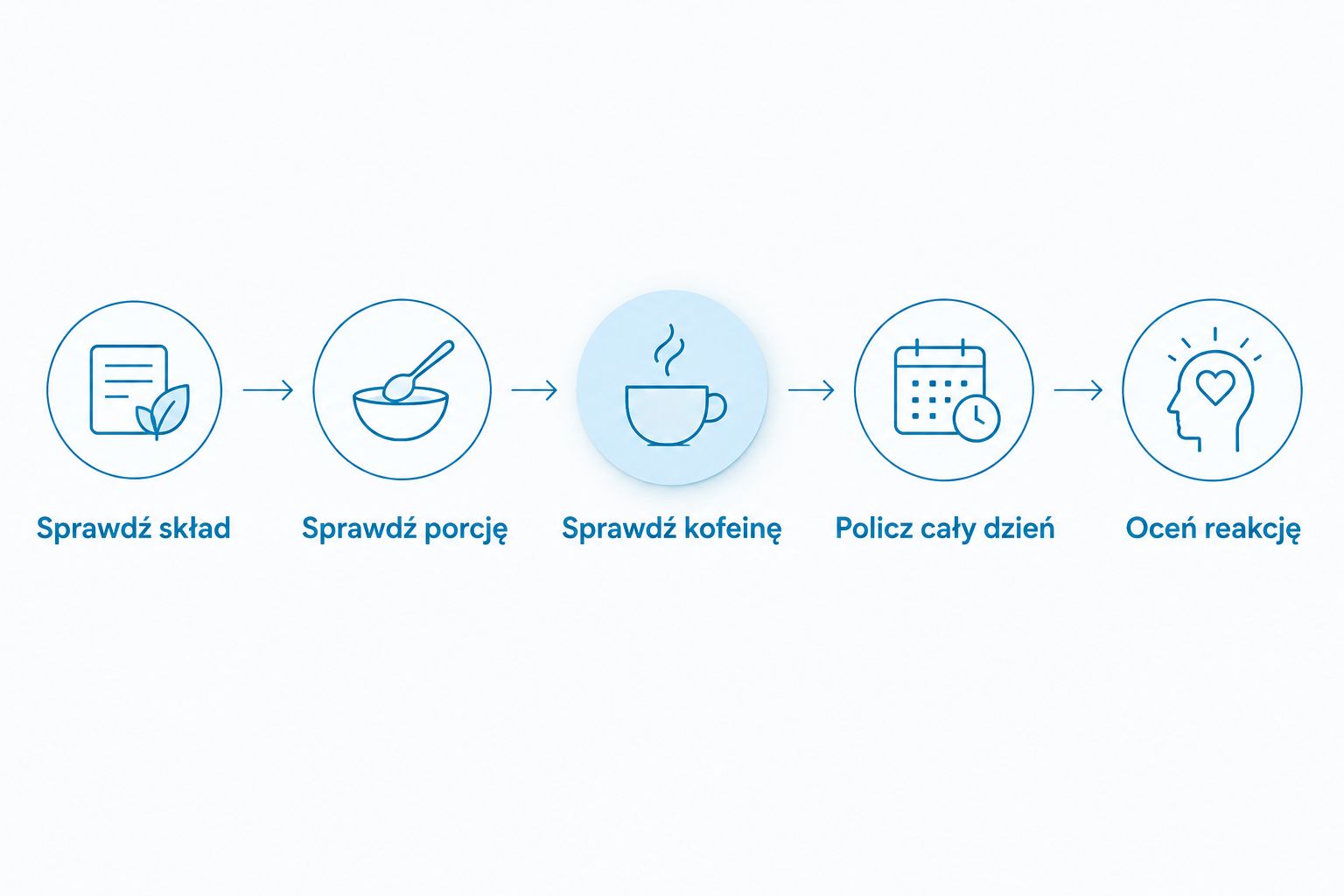
- Check the ingredients. Find matcha or other tea ingredients. Also pay attention to other potential sources of caffeine.
- Check the portion. Determine how much powder the manufacturer requires to prepare the drink. Don't treat any scoop you take as a certain portion.
- Check the caffeine. Look for the declaration of the amount of caffeine and the unit it refers to. Differentiate data for powder and finished drink.
- Count the whole day. Include coffee, tea, energy drinks and other products containing caffeine.
- Assess the reaction. Pay attention to sleep, restlessness, tremors and heart palpitations. Don't increase the portion just because the drink contains collagen.
If the manufacturer lists the caffeine content for a specific amount of powder, refer it to the amount actually used. Do not directly compare data for a dry mix with data for a cup of drink. These are different calculation bases.
When the information does not allow you to determine the dose per serving, ask the manufacturer. This is a better step than attributing to the drink the value found with other matcha. When strictly limiting caffeine, you need product-specific data.
How much caffeine should you include in a day?
400 mg of caffeine per day is a level that EFSA assesses to be of no safety concern in healthy adults, except pregnant women. Includes caffeine from all sources. It is not a recommendation to consume this much, nor a guarantee that every person will not experience any symptoms.
200 mg of caffeine at one time is a level that, according to the EFSA, does not raise safety concerns in healthy adults. This value does not indicate the caffeine content of matcha with collagen. When assessing one consumption occasion, also include coffee or other drinks consumed with matcha.
200 mg of caffeine per day is the level recommended by EFSA for pregnant women, at which no safety concerns for the fetus have been identified. This is about the total amount from all sources, not a separate limit for tea. Pregnancy therefore requires particularly careful control of portion sizes.
The source of these values is the caffeine safety assessment of the European Food Safety Authority, or EFSA. When planning your intake in 2026, consider these as general reference levels for the groups described, rather than individual medical advice.
If you have a disease, take medications or have been advised to limit caffeine, set your own rules with your doctor or pharmacist. Caffeine symptoms are a reason to change your intake, even if you don't exceed your overall baseline. You don't have to go to the limit to react.
Does collagen alleviate agitation after matcha?
Collagen does not neutralize caffeine and is not a basis for promising weaker stimulation. The addition of a protein ingredient does not mean that the drink ceases to function as a product containing caffeine. Don't use it as a hedge against insomnia or anxiety.
Matcha also contains L-theanine, but its presence does not remove caffeine. The terms calm or stable arousal do not mean safety for every sensitive person. Your own reaction still matters.
If regular matcha makes it difficult for you to fall asleep, don't assume that the collagen version will solve the problem. Check the dose, change the time of consumption or give up caffeine. Adding additional ingredients does not replace these decisions.
Does milk reduce the amount of caffeine in matcha lattes?
Milk does not remove the caffeine from matcha; reduces its concentration by increasing the volume of the drink. If you use the same amount of powder and drink the entire drink, you are consuming the same amount of caffeine from matcha. This also applies to coconut milk and other plant-based drinks.
This difference explains a common mistake: a milder taste does not mean a smaller dose. Latte has a different consistency than matcha with water, but the caffeine is still determined by the amount of tea used. Adding ice or more water works similarly.
If you want to limit caffeine, control the amount of the ingredient that provides it. Just making the cup bigger doesn't do it. When using ready-made mixtures, follow the manufacturer's instructions and portion information.
Can you drink matcha with collagen in the evening?
Matcha with collagen is not a decaffeinated drink for the evening. Caffeine can disturb sleep, and collagen does not tolerate this effect. If caffeinated drinks make it difficult for you to fall asleep, don't choose an evening latte just because of its protein component.
There is no one hour that fits everyone. What matters is sleep time, dose and individual sensitivity. Also monitor the quality of your sleep, not just whether you managed to fall asleep.
If you limit your arousal, this guide will be helpful matcha for people sensitive to caffeine. However, the basic principle remains the same: the presence of collagen does not allow you to omit caffeine from your daily schedule.
For whom does such a connection make sense?
Supersonicfood matcha latte is for people looking for a convenient combination of matcha, coconut milk and collagen. This is a choice regarding the form and ingredients of the drink, it is not possible to avoid caffeine. Rate it according to your purpose.
The advantage of the mixture is the combination of these ingredients in one product. The limitation is that their proportions result from the ready-made recipe: you do not regulate the amount of matcha itself independently of the other ingredients. If you want to carefully control each ingredient, preparing a drink from separate products gives you more freedom.
When shopping at Supersonicfood in 2026, pay attention primarily to the composition, preparation method and portion. Don't attribute caffeine-free or weight-loss benefits to a drink based on its name alone. Choose a combination that suits your diet and caffeine tolerance.
What mistakes should you avoid when drinking every day?
The most common trap is treating a functional drink as a product that does not need to be included alongside coffee. Matcha with collagen is still a source of caffeine. Store it in the same category as other caffeinated drinks.
- Don't just go by the name. Collagen, protein and milk describe the composition, but do not confirm the lack of caffeine.
- Don't convert a serving to a "cup full." The volume of the drink does not tell you how much powder you put in.
- Don't assume identical recipes. Data from one mixture does not automatically describe another.
- Don't ignore sleep. The lack of marked stimulation does not prove that caffeine does not affect rest.
A practical choice does not require a complicated plan. You just need to know your portion, take into account other sources of caffeine and respond to ailments. This is more useful than trying to find one drink that fits all.
FAQ
Does matcha with collagen contain caffeine?
Yes, matcha with collagen contains caffeine from matcha. Collagen itself is not its source and does not neutralize the caffeine present in tea.
How much caffeine does one serving of matcha with collagen have?
The amount of caffeine in a serving depends on the specific recipe and the amount of mixture used. Check the manufacturer's declaration for your portion; do not transfer value from another product.
Does collagen remove caffeine from matcha?
No, collagen does not remove caffeine from matcha. Adding it to a drink does not make the latte decaffeinated.
Does matcha with coconut milk have less caffeine?
Adding coconut milk to the same serving of matcha does not reduce the total amount of caffeine. It dilutes the drink, but when you drink it all, you still consume the caffeine from the matcha used.
Can I drink matcha with collagen before bed?
Matcha with collagen contains caffeine, so do not treat it as a decaffeinated drink before bed. If caffeine makes it difficult for you to fall asleep, choose a different time of consumption or a caffeine-free drink.
How much caffeine should you include per day in 2026?
400 mg of caffeine per day is a level that EFSA says does not raise safety concerns in healthy adults other than pregnant women. It covers all sources of caffeine and does not guarantee the absence of symptoms in every person.
Can you skip caffeine from matcha with collagen during pregnancy?
No, during pregnancy, caffeine from matcha with collagen must be included in the daily amount. EFSA identifies 200 mg of caffeine per day from all sources as a level at which no fetal safety concerns have been identified; Discuss individual recommendations with your doctor.
Finally: a larger cup does not mean a smaller dose
If you prepare matcha with collagen from the same portion of powder, adding water or milk will not remove the caffeine. It will change the volume and taste. Control the portion of matcha, not the size of the cup.
Before your next preparation, check one thing: whether you know the amount of caffeine assigned to the portion you actually drink. If you're limiting caffeine for health reasons, get this information from the manufacturer instead of guessing based on taste.
Related guides


